0
0

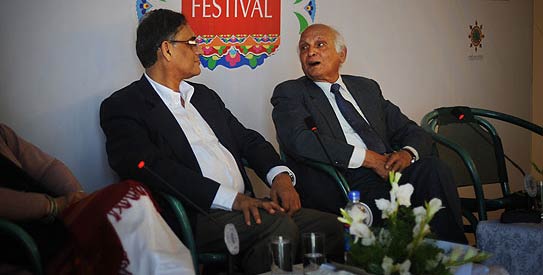
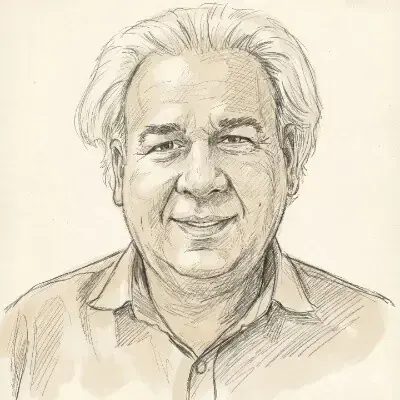
KARACHI: A fascinating question-answer session with eminent writer Intizar Husain made a select gathering of scholars revisit certain important issues pertaining to Urdu literature at the Anjuman Taraqqi-i-Urdu's office on Thursday.
Asked about whether he'd pen a book on poet Nasir Kazmi, with whom he'd spent a considerable time, Mr Husain said though he had written a couple of articles on him, he could not write on the body of work that the poet produced as it was the critics' duty; all he had was impressions on Kazmi's poetry. "Once I wrote the foreword to Ahmed Mushtaq's book because I was afraid of him. Had I turned him down he [Mushtaq] would have been angry. Nasir Kazmi and I had spent a lot of time together in spite of the fact that he was a bit of a la ubali [carefree person] and would spend his nights on the street, while I led a relatively 'normal' life. Still, I used to accompany him. When I got married, he commented, 'ab tum meray kaam ke nahin rahay' [you are of no use to me anymore]."This brought the questioner to the subject of Mr Kazmi's better half. Mr Husain replied she was an ideal wife. He said even when he'd reach home late in the night and his friends would not let go of a certain topic at the threshold of his house, his wife would be standing there waiting for a long stretch of time for her husband.
Reacting to the accusation that he had often changed his sociopolitical stance in his books, Mr Husain said thoughts altered from time to time. He said a critic of the stature of M.H. Askari used to say he changed his opinion without a trace of shame (main bay hayaee say rai badal laita hoon) .
He, however, said that transformation in stories happened on an unconscious level. This led him to remark that after living in Pakistan, he realised that a pure Islamic society could be ruthless. While mosques in Pakistan were attacked, even today this could not happen in India, he said. "It's a strange experience."
He told the audience that a president of Pakistan had claimed 'Muslims can't kill Muslims in mosques'. He was mistaken. Perhaps he hadn't read history. The problem with us is that we tend to remember the palatable parts of history and overlook the not-so-palatable ones. He iterated that now divisions like communist-Islamic or progressive-regressive sounded fake ( masnuee ) to him.
On the issue of his novels, Mr Husain said there was a time when people dubbed him a pessimist, and the progressives reprimanded him for not giving a ray of hope to people. He argued that when he migrated to Pakistan it dawned on him what relation he had with the land that he had left. Then those things recurred to him and he embarked on a journey into the past. But he could not tell anyone what that journey meant.
Mr Husain said when he penned the novel Aagey Samandar Hai he was criticised for writing about the migrant community. Actually, he clarified, every such book, including Basti , was in the context of the subcontinent and its Muslims' destiny. "There's no story of mine which does not have any relation to the situation in Pakistan." He said people told him that in one of his books he'd made Karachi the epicentre of his story despite not living in the city, to which his response was that it was not necessary to be physically present somewhere in order to write about that place.
Before the question-answer bit, Mr Husain briefly informed the gathering on the genesis of the book on Hakim Ajmal Khan.
Prof Sahar Ansari earlier formally introduced the distinguished writer to the audience and touched on his work of fiction and nonfiction.
Azfar Rizvi was the host of the programme, which was organised by the Anjuman Taraqqi-i-Urdu.