0
0

ISLAMABAD: The next budget is expected to focus on the poor, youths and new development schemes. As usual, government employees are likely to get a raise.
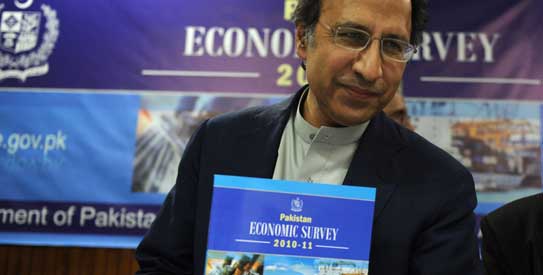
Sources told Dawn that a meeting presided over by Prime Minister’s Adviser on Finance Abdul Hafeez Shaikh on Sunday deliberated at length the outreach of the multi-billion rupees Benazir Income Support Programme (BISP) and decided to introduce a health insurance scheme in the first phase for at least 60,000 of 3.5 million families registered for the programme.
They said a decision for payment of electricity bills of poor consumers through the BISP was deferred when some advisers said the step would encourage illegal connections because only 10 per cent of the poor had legal power connections.
The meeting was also warned that the payment of power bills through the BISP would legalise unauthorised power consumption and could lead to misuse and create a political controversy.
The sources said the meeting was informed that 98 per cent of income survey had been completed and was going through audit and verification process which would follow issuance of credible cards. The BISP may also undertake health, education and training schemes.
The board of directors wanted a five-year business plan to make the programme sustainable. A pilot project for health insurance would be launched in Faisalabad within two weeks, said an official who attended the meeting.
A senior official in the finance ministry, however, watered down reports about a relief-oriented election year budget and said this would mean compromising fiscal discipline. But he confirmed that government employees would get a raise in the budget. It would be the fifth consecutive salary increase with a combined impact of over 125 per cent.
He said economic managers were not under any pressure to undertake politically-motivated projects under the Public Sector Development Programme, but indicated that the size of PSDP might be increased to about Rs350 billion from current year’s Rs284 billion after taking into account the combined impact of growth and inflation at 16 per cent and some minor increases for political reasons, saying it could not be increased to Rs500 billion given the limited fiscal space.
The official, however, conceded that economic managers would be under pressure to accommodate foreign-funded projects because of higher than anticipated foreign inflows for project financing and said the government could not block foreign inflows related to the BISP.
The official said any government was usually tempted to announce relief measures, but economic team had not been given any such directive by President Asif Ali Zardari. A number of requests from parliamentarians and other influential people for development schemes were being resisted on sound economic reasons, he added.
During a recent briefing to the prime minister, the sources said, Deputy Chairman of the Planning Commission Dr Nadeem ul Haque was directed to design special schemes for the youth in the next PSDP through a consultative process with university students.
As a follow-up, the planning commission hurriedly arranged consultative sessions with some universities in the twin cities on Monday on possible programmes in view of the fact that the government did not have adequate resources to provide jobs in large numbers. A few dozen students from Fatima Jinnah Women University, Air University, Comsats University, National University of Modern Languages, Roots and Bahria attended.
Students recommended special projects along with technical training on the pattern of schemes being pursued in Northern Areas by the Aga Khan Development Network. Some others proposed expansion of the youth internship programme to the private sector through budgetary incentives to enhance capabilities of the youth.
The students called for strict laws to protect intellectual property rights because they believed it was discouraging for youths that fresh entrepreneurship ideas were stolen by people in the industry.