0
0

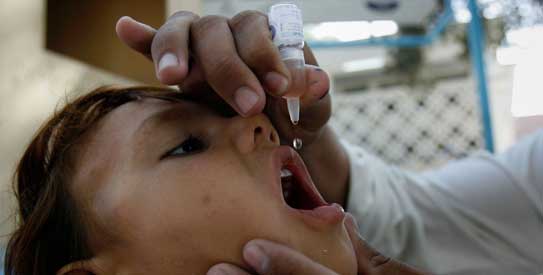
KARACHI: Senior paediatricians and child health activists said at a press conference on Tuesday that oral vaccines used in national campaigns against polio could in no condition cause death.
Insisting that there was no credible correlation between polio vaccination and infant deaths, the experts said that even an expired vaccine administered to children would cause no negative health impact on them.
Those who spoke at the press conference held by the Pakistan Paediatric Association included Dr A. Gaffar Billoo, Prof Dr Zareen Fasih, Prof Iqbal Memon and Dr Khalid Jafer.
PPA general secretary Dr Fasih said the association was perturbed by the fact that Pakistan was today the largest polio case reporting country in the world and was being dubbed ‘a polio danger zone’.
She said: “The number of polio cases fell from 1,555 in 1997 to 28 in 2005, but it rose in 2011 to 198, the highest figure in any country for the second consecutive year.
She suggested that routine immunisation of children be geared up and effective OPV campaigns carried out. She said the problem was that not every child under the age of five received anti-polio vaccine.
However, this lapse was due to the prevailing insecurity that discouraged parents from opening their doors to strangers. She also blamed it on clerics lacking necessary education and TV channels making claims about polio vaccines without doing proper research.
Referring to a series of programmes on polio vaccination telecast by a channel recently, Dr Fasih said the PPA had conveyed its protest to the National Electric Power Regulatory Authority saying the programmes had caused irreparable damage to polio eradication activities in the country.
Senior professor of paediatrics at a private university Dr Billoo said it was not correct to say that any OPV vial either expired or showing poor vaccine vial monitoring grades could cause death to children vaccinated with it. He further said that polio vaccines procured every year with the involvement of the World Health Organisation and the United Nations Children’s Fund for use during polio campaigns were all of international standard and had an equal success story both in developed and developing countries. “One can say that due to improper cold chain system at any level or carelessness on the part of the campaign executers there remains a chance of a vaccine losing its efficacy,” he said and added that such vaccination could not help eradicate polio in the country, but it did not have any negative impact on children either.
He said the only way to success in fight against polio was to ensure 90 per cent and above coverage of children in the national supplemental immunisation days and routine vaccination exercises.
He clarified that the PPA or child physicians at no level had asked parents to disallow vaccine campaigners to vaccinate their children as they had already been vaccinated against polio by private doctors. “There is no harm in repeating the OPV doses in children of the relevant age,” he said, adding that parents in posh areas had been wrongly linking their unwillingness to family physicians or child specialists.
Prof Iqbal Memon, the president-elect of the PPA, said it was embarrassing for Pakistan to be unable to eradicate polio.
Bangladesh, faced with multiple problems of poverty, sanitation, etc, and India, many times larger than Pakistan, had eradicated poliovirus as both the authorities and populations were committed to the cause there. “We have substantially been late in eradicating small pox and now new polio case reporting is proving another black spot and we are on the verge of receiving discriminatory treatment from other countries,” he said. “Our environment is full of poliovirus and as such we need to protect our children through maximum and timely OPV administration, which is possible once all the stakeholders work on the same wavelength.”
Replying to questions, speakers said there was a dire need to make health officers at district level answerable for their failure.
Besides, training of vaccinators and lady health workers, improvement of sanitary conditions in the high-risk areas, involvement of ulema having knowledge of the subject of polio, and a true commitment of government and political figures were essential for the eradication of polio from Pakistan.