



 0
0

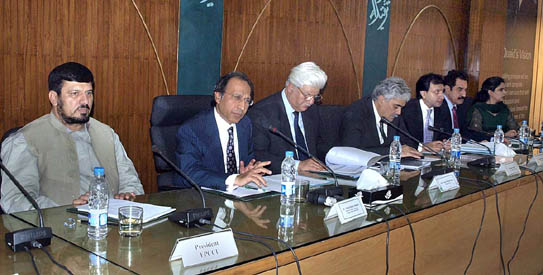
ISLAMABAD: A day before repaying $400 million to the International Monetary Fund (IMF), managers of the country’s economy said on Thursday that despite severe political pressures they would try to ensure that economic stabilisation achieved in difficult times was not compromised.
During a background briefing to journalists, the government’s team of economic experts confirmed that losses due to deficiencies in the power sector were over and above the 3.1 per cent fiscal deficit recorded in the first seven months of the current fiscal year.
A finance ministry official, however, acknowledged that the tradition of maintaining a two-tier deficit recording system should be done away with to ensure transparency.
The official confirmed that out of the $1.2 billion payable during the current fiscal, the first payment (of $400 million) would be made to the IMF on Friday.
He said the Rs900 billion to be transferred to the provinces under the 7th National Finance Commission award would result in provision of better healthcare, education and municipal services and in improving the law and order situation. However, he could not explain why lawlessness was growing rapidly in Balochistan despite increase in transfers to the province from a few billion rupees in recent years to Rs200 billion this year.
He also declined to say if there was any relation between additional resources and political unrest and if enhanced allocations were really being transferred to Balochistan, and also being spent there.
Another official said the Balochistan issue could not be resolved only through additional resources. He was of the opinion that the provincial government did not have the capacity to absorb the additional funds.
A top functionary parried a question about the reduction in rate of capital gains tax on stock exchanges after unanimous adoption by the parliament of an adequate tax rate.
He said agriculture income tax was a provincial subject and that the federal government could not force the provinces to impose it. He did not talk about taxes collected on account of capital gains tax in two years.
Increasing oil prices in the international market, coupled with any slippage on three key targets (inflows on account of coalition support fund, third generation telecom licences and PTCL proceeds from Etisalat), could pose serious challenges vis-à-vis balance of payment position, foreign exchange reserves and fiscal deficit despite strong performance on external account and expenditure restraint.
“Yes, there are pressures and the prime minister did order release of funds to parliamentarians, but what needs to be seen is how many of these demands really work. Political leaderships make political statements… but you have to see how many of these statements are honoured.
“It is wrong to say that all of the political instructions are implemented and economic management is compromised,” said an emotional member of the economic team.
He tried to dispel the impression that political pressures would set the tone for the next budget. He said the government had taken difficult economic decisions in national interest, as was evident from the tax measures and deregulation of oil prices.
But he agreed that some difficult decisions, like introduction of value-added tax, could not be implemented due to differences of opinion in the parliament.
He said that despite political pressures, the government would continue with its policy of fiscal austerity, economic stability and revenue mobilisation to give a message to the international community that Pakistan was a responsible country. At the same time, however, the difficulties faced by the public would be taken into account and attempts would be made to lend support to the vulnerable sections of society in a cost-effective manner.
The official ruled out any reduction in oil prices and said that prices in the international market were beyond the government’s control. He added that any reduction in tax collection would result in higher fiscal deficit, leading to greater borrowing, more printing of currency and higher inflation.




























