0
0

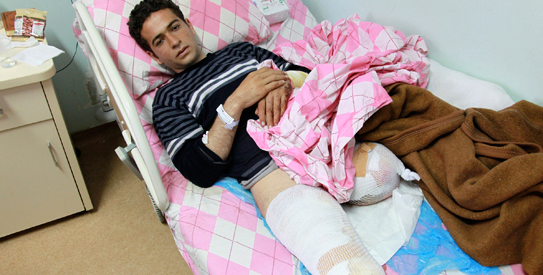
TRIPOLI: For three long weeks, Murhaf was stuck in Homs' notorious Baba Amr district, in central Syria. By the time he got to hospital in Lebanon, like many others, he had to undergo an amputation.
The 30-year-old is among a growing number of Syrians wounded in the violence sweeping their country and losing limbs for lack of proper medical care, especially in opposition strongholds targeted by regime forces.
“I was wounded about six weeks ago during the shelling on Baba Amr,” said Murhaf, sitting in his hospital bed in the northern Lebanese coastal city of Tripoli, where he is being treated.
“A shell fell next to me and I was taken to a field hospital,” he added, pointing to a heavily bandaged stump where his right arm used to be.
Murhaf, who worked at a car body shop, said doctors in Baba Amr managed to treat other wounds on his body but there was little they could do to save his arm.
“I could tell it was getting worse by the day,” he said, managing a smile despite his ordeal.
“The minute I reached the hospital in Tripoli, the verdict fell. My arm had to be amputated.” Muhannad, a Syrian doctor assisting the wounded arriving from across the border to Tripoli, said amputations were on the rise given the lack of adequate medical care and facilities in Syria.
Although there are no clear overall statistics, Muhannad, who asked that his full name not be used, said five amputations were performed on wounded Syrians in the past month at the state hospital in Tripoli.
“Some of the injured arrive in Lebanon several days after being wounded and by that time there is no other option but to amputate,” he said.
“Otherwise you risk too many complications that could be dangerous.”
He said the worst cases were victims who remain without medical care for weeks and arrive in Lebanon in really bad shape, often with serious infections.
Khaled, 32, said he waited for two weeks at a field hospital in Baba Amr before being moved to Lebanon, where doctors were unable to save his right leg.
“I was in a car with my brother when a mortar fell on us,” he said.
“The driver was killed and me and my brother were wounded.” He said field hospitals in Syria were overwhelmed and were forced to tend to the most critical cases before turning their attention to those with non life-threatening wounds.
“Those who are not on their death bed have to wait,” he said. “That's why moving me to Lebanon took a while.”
Compounding the problem for the wounded are the poor sanitary conditions surrounding their evacuation to Lebanon.
Many are forced to flee by foot, motorbike or donkey to evade Syrian army checkpoints.
“The majority of the wounded pick up infections before they get here,” said Muhannad, the Syrian doctor in Tripoli.
There are some 8,000 Syrians currently registered with the UN refugee agency in Lebanon. The majority are living in the mainly Sunni Muslim north of the country, in an area close to the border with Syria.
Lebanon's High Relief Council is helping cover the medical costs of the wounded and for emergency cases, an official said.
Muhannad said Arab countries and Lebanese officials have vowed to help pay for artificial limbs to those who undergo amputations.
“We prepared all the files and sent it to them,” he said.
Meanwhile Murhaf, who is to be released from hospital this week, said he planned to stay in Lebanon to help the other wounded.
“We had a farewell party this week at the hospital and I used my left hand to wave the flag of the revolution,” he said.