1
1

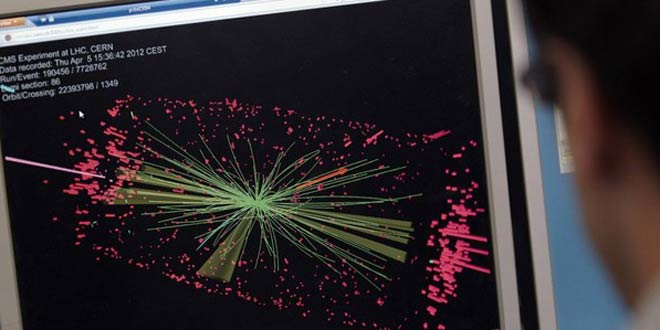
GENEVA: The world’s largest particle collider notched up a new record on Thursday as it escalated its quest to find fundamental matter and explore the origins of the Universe, CERN said.
At 00:38 am Thursday (2238 GMT Wednesday), the Large Hadron Collider (LHC) brought together two opposing beams of protons, each with an energy of four teraelectronvolts, the European Organisation for Nuclear Research (CERN) said in a press release.
“The collision energy of 8 TeV is a new world record, and increases the machine’s discovery potential considerably,” it said.
The LHC comprises a ring-shaped tunnel near Geneva, 27 kilometres long and up to 175 metres below ground.
Beams of protons are accelerated in opposed directions to nearly the speed of light.
Superconducting magnets “bend” the beams so that the particle streams collide within four large chambers. Swathing the chambers are detectors that give a 3-D image of the traces of sub-atomic particles hurled out from the protons’ destruction.
The tracks are then scrutinised for movements, properties or novel particles that could advance understanding of matter.
The big goal of 2012 is to determine the existence or otherwise of the Higgs Boson, which according to a theory of matter called the Standard Model would explain mass.
The LHC had been running smoothly for two years at a collision energy totalling 7 TeV before a winter break when the decision was made to escalate to 8 TeV.
“Although the increase in collision energy is relatively modest, it translates to an increased discovery potential,” CERN said.
Higher energy collisions mean that Higgs Bosons, if they exist, will be produced more copiously, the organisation said.
On the other hand, they also boost background noise that mimicks the likely signal of the Higgs.
“That means that the full year’s running will still be necessary to convert the tantalising hints seen in 2011 into a discovery, or to rule out the Standard Model Higgs particle altogether,” CERN said.
Thursday’s increase also hikes the potential for creating hoped-for “supersymmetrical” particles.
These could explain why visible matter only accounts for some four per cent of the cosmos. Dark matter (23 per cent) and dark energy (73 per cent) account for the rest.
The LHC is scheduled to run until the end of 2012, when it will go into a long maintenance shutdown ahead of running at 13 TeV from late 2014, ultimately ramping up to its designed maximum of 14 TeV.
LHC collisions amount to a high concentration of energy but only at an extraordinarily tiny scale. One TeV is the equivalent energy of motion of a flying mosquito, according to CERN.