1
1

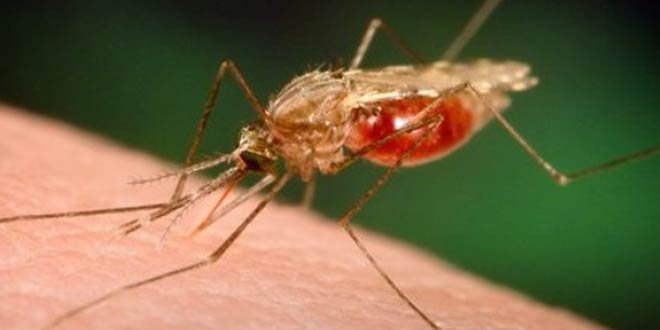
WASHINGTON: Deadly malaria that is resistant to drug treatment has spread rapidly to the border between Thailand and Myanmar, raising concerns of an uncontrollable epidemic, scientists said Thursday.
A pair of studies published in The Lancet and the journal Science showed how the disease is moving fast into new territory and identified a region of the parasite's genome that may be responsible for mutating in order to survive.
Malaria is a mosquito-borne disease commonly caused by a parasite, Plasmodium falciparum, that kills up to 1.2 million people year according to 2010 estimates by by the Institute of Health Metrics and Evaluation at the University of Washington, Seattle.
Malaria that was resistant to treatment with the current standard therapy, artemisinin, was confirmed in Cambodia in 2006 and has since surged 800 kilometers (500 miles) westward to the Thailand-Myanmar border, the researchers said.
By studying 3,202 patients along the northwestern border of Thailand near Myanmar from 2001 and 2010 and measuring the time it took them to clear malaria infections from their blood after treatment, scientists were able to show a steady increase in drug resistance.
The number of slow-clearing infections rose from 0.6 per cent of cases treated in 2001 to 20 per cent in 2010.
In western Cambodia, 42 per cent of malaria cases were resistant between 2007 and 2010, indicating that the Thailand-Myanmar region was swiftly catching up to Cambodia's rates.
“Genetically determined artemisinin resistance in P. falciparum emerged along the Thailand-Myanmar border at least eight years ago and has since increased substantially,” said The Lancet study.
“At this rate of increase, resistance will reach rates reported in western Cambodia in two to six years.”The research in the journal Science focused on what was making these parasites different, and found that a region on chromosome 13 of the parasite was strongly associated with slow clearance of infection.
They sequenced the genomes of 91 P. falciparum parasites from Cambodia and western Thailand and compared them to parasites from Laos, where resistance to the latest artemisinin-based drugs has not yet emerged.
They found seven genes that may be responsible for making the parasite resistant to drugs, and which may explain up to 35 per cent of the growing resistance in southeast Asia.
“We have now seen the emergence of malaria resistant to our best drugs, and these resistant parasites are not confined to western Cambodia,” said leader of the study Francois Nosten, director of the Shoklo Malaria Research Unit that studies and treats malaria in the Thai-Myanmar region.
“This is very worrying indeed and suggests that we are in a race against time to control malaria in these regions before drug resistance worsens and develops and spreads further.” The two studies were funded by the Wellcome Trust and the US National Institutes of Health, and included scientists from Mahidol University, Bangkok; the Centre for Tropical Medicine at Britain's Oxford University; and the Texas Biomedical Research Institute in the United States.