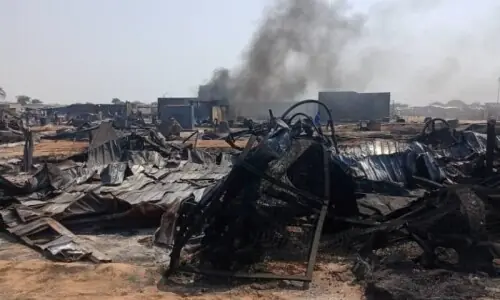
ISLAMABAD: The Pakistani military on Sunday resumed desperate efforts to find survivors after an avalanche engulfed an army camp high in the mountains of Kashmir, leaving up to 135 people feared dead.
The increasingly frantic search on the Siachen Glacier, where Pakistani and Indian troops face off on what is known as the world's highest battlefield, was called off for the night late on Saturday because of darkness and poor weather.
More than 24 hours after the avalanche hit, a team of 150 soldiers, aided by sniffer dogs and helicopters, is yet to find a single body or survivor in the deeply inhospitable and remote region.
“No recovery has been made so far,” a military official said, adding that heavy machinery had been sent in and the rescue effort was in full swing.
The military said in a statement overnight that 135 people were missing from the camp, including 124 soldiers, after the avalanche smothered an area of one-square kilometre (a third of a square mile) early on Saturday.
The avalanche struck between 5 am and 6 am, security officials said, raising the possibility that some of those buried were asleep at the time.
A tailor and two hairdressers were among civilians missing in the thick snow in the militarised region, which is close to the de facto border withIndiain the Muslim-majorityKashmirregion.
Kashmir has caused two of the three wars between Indiaand Pakistansince their independence in 1947 from Britain. Siachen became a flashpoint whenIndia occupied key areas in 1984, including the heights, promptingPakistan to immediately respond by deploying its own forces.
The nuclear-armed rivals fought a fierce battle over Siachen in 1987, raising fears of all-out conflict, although the guns on the glacier have largely fallen silent since a slow-moving peace process was launched in 2004.
IndiaandPakistanhave spent heavily to keep a military presence on the glacier, where temperatures can plunge to minus 70 degrees Celsius (minus 95F).
New Delhireportedly spends more than 40 million rupees ($800,000) daily on its Siachen deployment — a figure that does not include additional wages and bonuses.
Experts have previously said thatIndiahas around 5,000 troops on the glacier, whilePakistanhas less than half that number. The harsh weather and altitude claim many more lives than actual fighting.
Avalanches and landslides frequently block roads and leave communities isolated in the mountains ofPakistan, neighbouringAfghanistanand inKashmir.
In February, at least 16 Indian soldiers on duty in the mountains ofKashmirwere killed when two avalanches swept through army camps.
President Asif Ali Zardari on Sunday became the first Pakistani head of state since 2005 to visitIndia, for a one-day trip aimed at building goodwill.