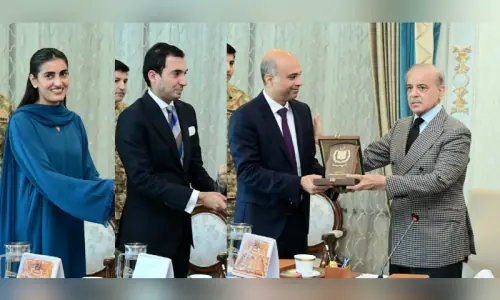
Despite Mr. Singh’s personal popularity with the electorate, the Indian National Congress, India’s ruling party, is fast crumbling as is evidenced by its dismal performance in the recent State elections in Uttar Pradesh. This makes the Zardari-Singh rendezvous a moot point. According to the below survey, Mr. Zardari’s party is about to lose an election. Whereas Mr. Singh’s party has just lost one.
The political leadership in both countries is at its weakest and the ever-so-powerful armed forces in India and Pakistan surprisingly enjoy higher approval ratings, leaving even media and religious leaders behind. In this politically uncertain climate, where the leading parties are being hounded by the opposition and the armed forces, the Zardari-Singh dialogue was unlikely to make any meaningful progress on the core issues that divide India and Pakistan.

Given the lack of substance in the Zardari-Singh dialogue, political pundits shifted their focus to the gastronomical particulars of Mr. Zardari’s meal with the Indian Prime Minister. Details about the lunch menu, from hors d'oeuvres to desserts, were headlined by the media in both countries. While the Indians and Pakistanis naively craved any news about the measures leading to peace and prosperity in the region, Zardari and his 40-member delegation devoured a rack of lamb, chicken kebabs, masala dosas, and blueberry mousse, to name a few.
Those digging for a greater meaning and symbolism for the visit skipped details of the menu and focused instead on the tweets by the Indian Prime Minister’s office and Bilawal Bhutto Zardari. In their haste, Indian and foreign media made errors in decoding Bilawal’s tweet: “AOA India Peace be with you”. While Bilawal used AoA as an acronym for Assalam-o-Alaikum (peace be with you), Sandeep Joshi of The Hindu and Jim Yardley for The New York Times interpreted AoA as Allah o Akbar! A subsequent version of Jim Yardley’ online draft carried the correction.
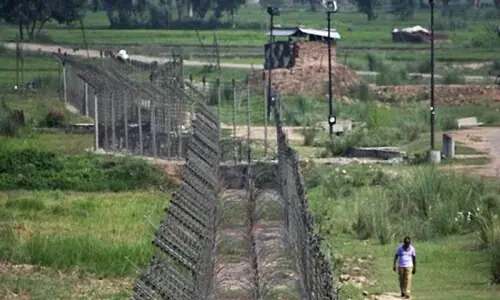
More than six decades after independence, India and Pakistan remain continents apart on the future of Kashmir and Kashmiris, which has diverted hundreds of billions of dollars to warfare that could have been invested in improving the welfare of the very poor who remain destitute, illiterate, and malnourished. The resolution of the Kashmir issue has eluded even the most powerful political leaderships in South Asia in the past. Hopes of deliverance from the present lame duck leadership on either side of the Wagah border have been greatly misplaced.
And while the leading political parties in India and Pakistan are experiencing new lows in voter confidence, the masses in both countries indeed look forward to resolving the outstanding issues. More than 70 per cent of Pakistanis and Indians believe in improving relations between the countries. Almost 70 per cent of the people in both countries also feel strongly about improving trade ties. Pakistanis, however, are overly fixated on the Kashmir issue where 80 per cent of Pakistanis and 66 per cent of Indians believe it is important to resolve the Kashmir dispute.
The desire to improve relations and trade, and resolve outstanding issues exists in an environment of mutual distrust. A large number of Pakistanis (57 per cent) see India as the biggest threat to their future. In comparison, only 19 per cent of Pakistanis see al Qaeda as a threat. Even a larger numbers of Indians (70 per cent) remain wary of Pakistan. However, the Indians are more nuanced in their concerns about Pakistan. They are increasingly concerned (77 per cent) about Pakistan-based militants, such as Lashkar-e-Taiba.
One can sense the winds of change blowing across the political landscapes of India and Pakistan. The Pakistan People’s Party and the Indian National Congress are unlikely to hold on to power in the next elections. Even if the leadership of these parties is handed to their respective political orphans, Bilawal in Pakistan and Rahul in India, the inescapable reality remains that the two parties have squandered the political capital they had at the start of their tenure. In 2008, for instance, 64 per cent of Pakistanis had a favourable view of President Zardari, which collapsed to 11 per cent in 2011.
In Pakistan Imran Khan’s political fortunes have been on the rise. However, Mr. Khan's party indeed experienced a backlash after it welcomed in its ranks those who had sided earlier with military dictators, additionally many consider Mr. Khan to be the ISI’s Manchurian Candidate who is expected to side with Pakistan’s conservative right. Still Mr. Khan has been able to galvanise a large number of disillusioned urban youth leading some to believe that his party may end up commanding majority in the forthcoming elections in Pakistan.
In India, Gujrat’s chief minister, Narendra Modi, who was accused of conspiring in the riots that resulted in 2,000 Muslim deaths, has been found innocent of the charges against him by an investigation team appointed by the Supreme Court of India. He is also being touted as BJP’s candidate for the office of prime minister in the next elections in 2014, especially after last year when a US Congressional research paper praised him for effective governance.
Like Imran Khan, who is at least perceived as pandering to the right-wing conservatives in Pakistan, Modi is also viewed as a representative of the right-wing conservatives in India. Some dread the very prospect of supposedly hard-line, right-wing conservative governments assuming power in Islamabad and New Delhi. However, one cannot ignore the lacklustre progress made by the left-leaning parties currently in power with their coalition partners in Pakistan and India.
If the next elections in Pakistan (expected in 2013) and India (2014) result again in split mandates, which would force the leading parties to form coalition governments, the prospects for peace will remain bleak regardless of a left or a right leaning party occupying the prime minister’s office. A strong mandate is a prerequisite for the next governments in India and Pakistan to have the confidence necessary to negotiate on matters that have failed to resolve in the past 65 years.
*Approval ratings and other figures reported in this piece are quoted from various publications produced by the Pew Global Attitudes Project.

The views expressed by this blogger and in the following reader comments do not necessarily reflect the views and policies of the Dawn Media Group.