0
0

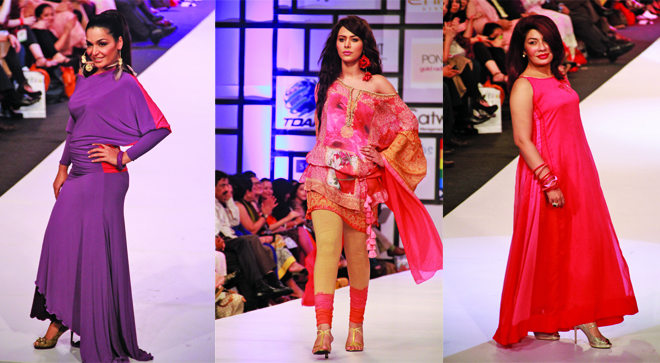
Under the supervision of Chairperson Shamaeel and CEO Maheen Khan, Fashion Pakistan Week 3 (hosted by FP, better known as Karachi’s council) brought some of the country’s most acclaimed design forces back to their rightful place: under the spotlight. It was high time it happened and though the four-day event left a lot of room for improvement, the designers at least proved that time lost had not rusted their sensibilities. The event’s shortcomings should be smoothed out by September, when FPW will showcase collections for Autumn/Winter 2012.
The High & Mighty
Sana Safinaz offered absolute respite from voiles to imprint equally powerful self-developed gold mesh fabrics. Their collection was high on oomph and red carpet glamour, a ready and welcome departure from the casual mode of lawn that Sana Hashwani and Safinaz Muneer have been more associated with lately. The ease with which they slipped into goddess mode could only come from designers with their experience of excellence.
Shamaeel committed to her trademark by developing separates garnered from floral bouquets and yet this collection was no wall-flower. Strong, powerful and yet feminine, the fragrance one got from her rose petal ashes was more scent of a woman than shrinking violet. Hers is a sensibility that can be trademarked as quintessential Shamaeel; it’s an ethos that says feminine need not be frail.
While Shamaeel’s collection was about bringing elements of style together, Maheen Khan’s was about deconstructing them for a timeless, minimal look. Hers was a collection that flirted with the figure, teased with a flash of bare shoulder or plunging back and pleased with the way it caressed the body. Pure silks—stripped of embellishment or any other binding elements—were allowed the freedom to move when put in motion. Contemporary, fluid and mercurial.
In her first ever fashion week showing, Pakistan’s greatest revivalist Bunto Kazmi opened FPW with an assimilation of 14 of her strongest pieces. Her showcase flaunted sartorial magnificence of the Nauroze cashmere shawl, the lyricism of the Hamza Nama and several Persian, Turkish and even French motifs rendered in techniques that are ubiquitous in the Bunto Kazmi signature. That they should be just as ingrained in Pakistan’s fashion legacy is the message one came away with.
And honing from white, ecru and bone blending into blacks, Iman Ahmed of Body Focus offered an assimilation of sartorial excellence expressed eloquently in fine detailing, inverted prints and the nonchalant yet perfectly created twists and turns of the fabric. This collection was truly sculptural, drawing one of Pakistan’s finest designers out of reclusion.
Awe that Iman achieved by means of design, Nomi Ansari generated with a show that was nothing short of a grand finale. He streamlined his ethos to minimally embellished colour blocking and lent fashion a sense of reality by dressing 20 ‘real people’ instead of models. Women as diverse as Zoe Viccaji and Nighat Misbah or Maheen Khan and Meera sashayed across as Ahmed Ali Butt belted out a live improvisation of I’m Sexy and I Know It. A crowd pleaser with no bounds, this show began and ended to thunderous applause.
Shehla Chatoor is one designer who has evolved through previous fashion weeks and this time around she cemented her reputation as a low-profile designer who has a definite signature. Her collection, streaming exotic leather and gold elements, also boasted very fine hand-crafted embroidery techniques (gaara) and placed them on modern, contemporary silhouettes. There was a refined, international appeal to it.
Karachi-based designer Ayesha Hashwani presented her most impressive collection to date and the efforts she put into her black and white range especially, was very visible. She will undoubtedly find more acclaim if she can continuously improvise an aesthetic that is too often under-written (off) as high-society safety wear.
Last but not least, Ahmed Bham came across as the only menswear designer that impressed at FPW. Despite having over a decade of designing bespoke for a cross-section of clients from Islamabad to Karachi, this was Bham’s fashion week debut and he deviated from his signature classic look to leave an ever-lasting impression. It was a collection that prescribed a resort getaway, a sandy wedding or a pool-side soiree.
Misses: Deepak Perwani, as one has seen much better from him in recent years and Umar Sayeed, as his collection began with four new and interesting pieces but then rehashed too many old ones. Honey Waqar was inexplicably gifted the honour of FPW’s grand finale (for being the council’s board member from Lahore) but her Middle Eastern aesthetic was out of place on a platform that was heralding modern, progressive fashion.
The Young Guns
Other than fashion veterans, FPW S/S 2012 also offered a pool of younger and relatively unsung heroes of fashion that displayed potential brilliance and need to be looked out for.
Sanam Chaudhri’s edgy, florescent collection struck like a bolt of lightening and etched unforgettable energy into the opening day of FPW. This Indus Valley graduate has been on retail rise for the past one year and with this collection she created a mark of creative brilliance.
Someone who has already created a mark of conceptual brilliance and needs to work on retail: Rizwanullah showcased his strongest collection yet. The use of white rilli appliqué with coloured patchwork balanced out his interplay of sombre greys. One perceives Rizwanullah’s collection as a manifestation of his own psyche and it sure is interesting to read into.
While many young designers have previously done and overdone the ethnic angle/truck art in fashion, Wardha Saleem took it to the next level. Her collection played with fabric textures instead of leitmotifs of culture (the kite, pottery, flowers) and injected a very international appeal into it. Bohemian Pakistan for the world.
Maheen may be a veteren but her brand Gulabo is still young and it played a very youthful tune at fashion week. Motorbike helmets painted with truck art, models wearing Crocs and clothes that could be worn anywhere over the world and be immediately identified as Pakistani is what this collection was.
One surprise entry into this field was one year old label Baani D, conceptualised by two young NCA (National College of Arts) graduates—Aneeka and Salma—who took Desi Boho to an eclectic level. Impressive for debutants, Baani D put out colourful separates with Banarsi boots and convinced with both attention to detailing and a sound aesthetic.
Photographer Tapu Javeri made a fashion week debut with his collection of Karachakra bags boasting kitschy Karachi landscapes as well as celebrity portraits.
Models in abayas (designed by Atiya Khan) carried the bags and the show was an interesting pun on our society’s dichotomy whereby the veiled are erroneously stereotyped as simple.
There was nothing plain about the glamorous undertone of this show. Somewhere in purgatory, Zahid Bashir of Kuki Concepts indicated a very creative streak by juxtaposing ancient Banarsi fabrics but the collection’s inconsistency (yet again) was confusing.
Misses: Feeha Jamshed is capable of so much more while Sanam Agha has let-down one time too many. Tayyab Bombal has proven that he is not runway material while Abdul Samad did the unforgivable by dedicating a B-grade collection to Jinnah and then mocking it with faux Jinnah-esque models. Pinx showed no potential whatsoever while Arsalaan Yahseer and Ayesha Somaya need mentoring and guidance from council seniors to ascertain whether they can evolve to being runway-worthy or not.