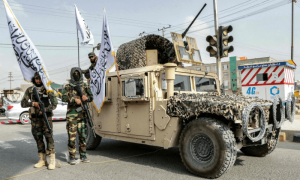
WASHINGTON: The Pentagon said Monday a major attack on Afghan government buildings, military bases and foreign embassies was likely carried out by Haqqani militants who operate from sanctuaries in neighboring Pakistan.
“Initial indications are that the Haqqani network was involved in this set of attacks that occurred yesterday in Kabul,” press secretary George Little said of Sunday's assault.
The 18-hour attack was “well-coordinated,” but Afghan security forces “did a very effective job” in quelling the onslaught, Little told reporters.
It was not surprising that insurgents had launched an attack with the advent of spring, when fighting usually escalates in Afghanistan, he said.
“We thought something like this may very well happen and it did,” he said.
Although Afghan President Hamid Karzai had complained about an intelligence failure by Afghan and especially Nato-led troops, the Pentagon spokesman said it was not realistic to expect coalition forces to know in advance about every insurgent operation.
“I don't believe this was an intelligence failure. We did sense that something like this might happen,” Little said.
He also rejected any comparison to the Tet offensive during the Vietnam war, saying it was not a large-scale military operation but instead a series of terror attacks.
“I'm not minimizing the seriousness of this but this is in no way” like the Tet offensive, “ he said.
In the biggest attack on Kabul in 10 years of war, squads of militants who had infiltrated the capital and taken up strategic positions in three locations fired on government buildings, embassies and foreign military bases before all 15 were killed.
A total of 51 people died, including 36 militants, and some 74 were wounded in Kabul and three neighboring provinces where government and military targets also came under synchronized attack, Afghan officials said.
Afghan security forces took the lead in responding to the attack while Nato provided helicopters.