Pakistan imploding under sectarian violence
After decades of waging the propaganda war against India for its highhanded treatment of Kashmiris, Pakistan is now the subject of a similar campaign by India who has highlighted the plight of Shias being murdered by sectarian terrorists in Gilgit-Baltistan.
The Asian News International reported recently that “in Gilgit-Baltistan, Pakistan’s only Shia dominated province, ethnic cleansing is being carried out systematically.” At the same time, the Shia-dominated town of Kargil in the Indian controlled Kashmir recently shut down the main bazaar in solidarity with the Shias of Gilgit and Chilas who were murdered in cold blood in early April. Several Sunni Muslims also lost their lives a few days later when sectarian violence broke out in the region.
The comparative statistics on terrorist violence between India and Pakistan speak volumes of how the tide has indeed turned against Pakistan. The data compiled by South Asian Terrorism Portal reveals that in the current year alone, approximately 150 civilians, mostly Shias, have died in sectarian violence in Pakistan. In comparison only 23 violent deaths were recorded in the Indian controlled Kashmir in 2012.
Even with a six-times larger demographic footprint, 62 civilians reportedly died in terrorist violence in India in 2012, whereas 734 civilians became victims of terrorist violence in Pakistan during the same time period. For decades, Pakistan had pointed finger at India and accused her of failing to protect the life and property of religious minorities. Today, Pakistan stands accused of the same where Muslims belonging to minority sects and others are being murdered while the state’s machinery has failed miserably to protect their lives and property.
Sectarian violence has spread to all corners of Pakistan. Only last week several Shias belonging to the Hazara tribe were gunned down by the Sunni extremists in a crowded market in Quetta. Later, Sunni militants called local newspapers and claimed responsibility for their murderous accomplishment. Over the past few years hundreds, if not thousands, of Shias have been murdered in Kurram Agency by Sunni extremists and Taliban factions who are reportedly aligned with Pakistan’s intelligence agencies. In other parts of Pakistan Shias have been taken off buses, lined up, and gunned down.
As of late, the followers of majority Sunni sects, such as Barelvis, have increasingly become targets of militants who are followers of radicalised Sunni sects. The attack on Data Darbar, the mausoleum of Lahore’s patron saint, in July 2010 left almost 50 moderate Sunni Muslims dead. In an earlier post, I reported police statistics which showed that almost 90 per cent of arrested terrorists in Pakistan were followers of the Deobandi sect.
It is only recently that the moderate Sunnis have been targeted by the followers of radical Sunni sects in Pakistan. However, for decades, Shias and other minorities were the only victims of extremist violence. The majority Sunnis, who never agreed with the murderous agenda of the few radicalised groups, however remained complacent and maintained a deafening silence over the murders of Shias and others, which escalated during the dark days of General Ziaul Haq. It was during General Zia’s time when madrassas were turned into military academies where intelligence operatives trained hundreds of thousands of Afghans, Arabs, and Pakistanis in warfare; equipped them with Kalashnikov assault rifles and Stringer missiles; and marched them into Afghanistan.
The widespread distribution of small arms weaponised the Afghan society to such extremes that after the withdrawal of the Soviet Army in 1989 successive Afghan regimes collapsed because of the in-fighting that continued between heavily armed Afghan militias who could not agree on a post-Soviet governance formula. While Afghanistan imploded in the early 90s as a direct result of military interventions by the Soviets, Americans, Saudis, and Pakistanis, several thousand alumni of the Afghan war returned to Pakistan to establish their own mini jihad factories in every nook and corner of Pakistan. For over a decade, the jihadis used Shias for target practice until they waged a full-fledged war against Pakistan’s establishment in 2001.
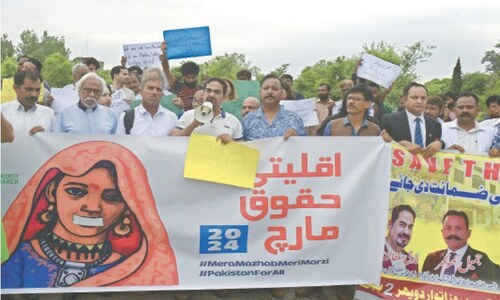
The patron-in-chief of the jihadis, including the Taliban, has been General Hameed Gul, who headed Pakistan’s Inter-Services Intelligence during the formative years when Russian-made weapons were shipped from Egypt and elsewhere to equip Afghans and others to fight the Red Army in Afghanistan. General Gul was recently confronted by an inimical group of Shias who were protesting outside the Parliament in Islamabad. As the crowd complained against his longstanding relationship with the militants leading terrorist attacks against Shias, the General instead came off as the biggest dove as he addressed the crowd while his son whispered speaking notes in his ear. General Hameed Gul claimed to have initiated deweaponising the militants before he was removed from ISI in June 1989.
I happened to meet General Hameed Gul in a suburb of Toronto in the mid-90s when he visited Canada. Sitting among a large group of devotees, General Gul spoke with pride of the “successes” achieved by the Taliban in Afghanistan. I specifically asked the General if he was at all concerned about the excessive spread of small arms and assault weapons in Pakistan and Afghanistan. His answer then was quite different from what he stated on April 10 in Islamabad. General Gul looked at me with barely concealed disgust and observed that weapons were the ornaments for men. “It is the same weapons that will come in handy to ward off the enemy,” proclaimed General Gul.
Since his proclamation in the mid-90s, the same ornaments have dispatched thousands of Pakistanis to their graves and have brought the state and the society to a near default. In the comity of nations, Pakistan is increasingly being referred to as a pariah state. Even the overseas Pakistanis now march outside Pakistani embassies to protest against the massacres of minorities that continue unabated. Wherea,s once Pakistan complained of human rights violations by India in the United Nations, other are now accusing Pakistan of the same.
As the violence increases in Pakistan, the rest of the world loses its confidence in Pakistan’s ability to meet her economic, legal, and moral obligations. If the sectarian and factional violence, which no longer targets only the Shias and other minorities, continues in Pakistan, it is likely that the state and the society will implode, as it has already in the neighbouring Afghanistan.
It is imperative for Pakistan’s military and civilian establishment to recognise that the time to act decisively against extremists in Pakistan has arrived. There is no room or time to play favourites and support the “good militants” who may side with the establishment for a short while, but the same good militants will most likely turn against their handlers, as they have done so repeatedly in the last few years.
Murtaza Haider, Ph.D. is the Associate Dean of research and graduate programs at the Ted Rogers School of Management at Ryerson University in Toronto. He can be reached by email at murtaza.haider@ryerson.ca
The views expressed by this blogger and in the following reader comments do not necessarily reflect the views and policies of the Dawn Media Group.




Why are people being killed today in an argument about something that happened thousands of years ago? I bet no matter which religion- Sunni or Shia condones the taking of a life.
Continued —4
This causes a conflict among Shias and Sunni extremist group. There are many fatwas from such Sunni extremist groups where they declared Shia as Kafirs and encourage their local followers to eliminate Shias as soon as possible. These Fatwas are condemned by true Sunni scholars and also is not popular among huge Majority of Sunni people world wide. On the other side Shias which are in minority in Pakistan are not stop condemning Yazeed Ibne Muawia Ibne Abu Sufyan and considered him, his ancestors & his followers the worse enemy of Islam.
One can easily conclude that battle is between the group of people who love Yazeed Ibne Muawiya Ibne AbuSufyan with those who hate and condemn Yazeed Ibne Muawiya Ibne Abusufyan and his followers.
Today History is repeating itself when the followers of Yazeed Ibne Muawiya wants massacre of the followers of Hussain Ibne Prophet Muhammad.
I salute You Murtaza for being so outspoken on this issue. I am providing here an unbiased comments of Mr. ShivChandra Dev a Hindu scholar, which I find as an eyeopener to all readers.
Massacre of Shia Muslims in Pakistan.(By : Professor ShivChandra Dev.)
Recent cases of sectarian targeted killings in Pakistan force me to think why is it happening that Muslims are killing each other in the name of Islam and what are the factors behind this thought which allow someone for this kind of butchery.
I realized that I must study the history of Islam as what had happened in past and what are the root causes. I go through & read so much literature over origination of Islam, Prophet Muhammad's teachings, teachings of Quran but didn't find a single case of such violence or hatred. There are many differences among these two major sects due to some historical events mentioned in all Shia Sunni authenticated history books.
Murtaza Haider's article is spot on. Pity I can't remember that old saying to the effect where the silent majority chose to remain silent against the excesses of their leaders until the day comes when there are no other opponents left. That is the time for the silent majority to be devoured in its turn.
"I agree with much of what the author has written in this paper. If you substitute Indian names for Pakistani names the description would equally suit the Indian situation to an amazing degree.
What I do not see in this analysis is a look at the causes that produce terror within Pakistan.
Among the causes is, to my mind, the free rein that has been allowed to so-called religious teachers who swear by what they consider to be the correct interpretation of Islam and Quran. It is this kind of teaching handed down from the mosque pulpits every week that is responsible for the attitude of jihad in the country, which expresses itself both within the country and outside the country.
No amount of legislation and law enforcement machinery will suffice to meet the situation if such weekly sermons continue to pour forth throughout the country, as if that were the basic message handed down by Allah through the prophet Muhammad. That kind of teaching needs to cease.
Besides, the entire system of madrassah education needs to make way for a modern education system that will encourage the growth of a scientific attitude and rational approach to matters relating to society and economy."
I find that Dr Murtaza Haider is saying things which I would have been saying if I had written on the subject. I couldn’t agree with him more.
It is important that Pakistan’s madrassahs, seminaries, and extremist outfits stop churning out their alumni who go forth to replenish and ranks of so-called extremists working for the glory of Islam by engaging in jihad – both inside Pakistan and outside.
I entirely agree with the author when he says, “If the sectarian and factional violence, which no longer targets only the Shias and other minorities, continues in Pakistan, it is likely that the state and the society will implode.”
I hope someone arises in Pakistan to stem the tide while there is still time.
V. C. Bhutani, Delhi, India, 22 Apr 2012, 1547 IST
We are talking about real life Mr. Bhutani, not Bhuta -Preta [ Ghosts and goblins] .
The situation in India and Pakistan is not similar. If it were, people like you would have moved to other countries long ago. Life of regular Muslims is becoming difficult this is the issue,
Good article by Mr Haider. IN UNITY lies STRENGTH and so we need to forget the differences that have long caused enmity amongst us and paved the way towards our own self-destruction. We need to accept diversity as an integral part of our day to day lives so as to bridge the gap between our multi-faceted society.
I hadn't read Dawn for quite some time. I returned, in a way to pay my respects, after hearing the news of your colleague's, Murtaza Razvi's, tragic murder. It was great to read this refreshing and honest piece Mr. Haider. It's been a depressing period, with the Gilgit-Baltistan and Hazara massacres, the NLI being buried in snow, and now the Bhoja airlines crash.
No pun intended. But what I read from the comments here, I see educated Pakistan is nowhere near the terrorism epicenter hackneyed Pakistan is. On the other side, I find real vile comments on Indian news websites. I don't know if it is a signal or a symbol.
Great analysis of the present situation in Pakistan. My congratulations. Please send a copy of the last paragraph to the ISI and Saeed.
" approximately 150 civilians, mostly Shias, have died in sectarian violence in Pakistan. In comparison only 23 violent deaths were recorded in the Indian controlled Kashmir in 2012 " . Were those 23 violent deaths in Indian controlled Kashmir all civilians or writer avioded givng the numbers of security personale also killed by militants ??????
Excellent article. Your next article should be on the weaponization of of the population of Pakistan. This, I beleive is a much bigger threat to Pakistan's existence than corruption that everyone and his brother in the media is focused on.
Pakistan is reaping the fruits of it's bad KARMA. Prior to patition non-Muslim population of present day Pakistan was 30%, with majority or near majority in Karanchi and Lahore. Today one has to send search party to fing a Hindu or a Sikh in Pakistan. Pakistan ethnically cleansed itself of Hindus and sikhs with tacit approval or Nehru and his daughter.
A very admirable and perceptive article. Mr Haider I hope is not risking his life. Pakistan was created as a separate home for the Muslims and those of the minority religions believed they will be able to live peacefully with their Muslim compatriots as during the long Muslim rule. But there was ethnic cleansing and the state was officially changed into an Islamic Republic. When you divide the same nation in the name of religion fundamentalism is inevitable and it becomes a duty to enforce only the true form of the religion of the believers in power and get rid of the dissidents.
Really nice article Mr Haider ….
Very nice article…..Quaid-E-Azam once said " it will take them a 100 years to become a nation" But he did not mention how long it will take them to become humans…..
Gr8 work sir….first time seen some unbiased article regarding sectarianism..