0
0

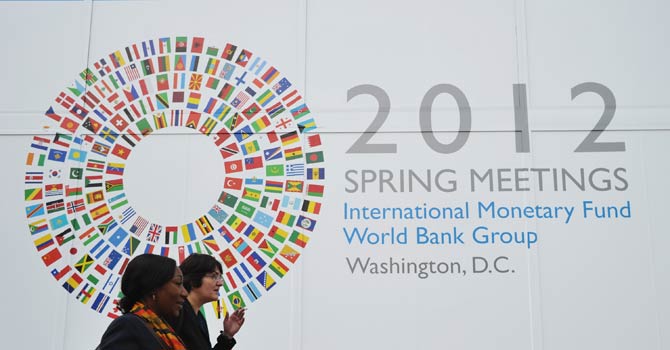
WASHINGTON: IMF head Christine Lagarde said Thursday that the crisis lender would get a significant boost to its intervention capacity this week as worries mounted that Spain might be the next eurozone country to seek a rescue.
Warning that “dark clouds” still hover over the global economy, she expressed confidence that International Monetary Fund members meeting in Washington would put up the funds needed for a “global firewall.”But with the United States not taking part, all eyes were on China and the other BRICS emerging powers to see if they would contribute some of their newfound wealth, knowing that some of it could go to more bailouts in Europe.
“As part of the outcome of this meeting, we expect our firepower to be significantly increased,” she said, hours after Poland and Switzerland declared their contributions to the $400 billion pool targeted to protect countries from any financial contagion from Europe.
“You've got lots of clouds out there,” she told journalists ahead of the annual IMF-World Bank spring meeting, calling the eurozone “the epicenter of potential risks.”Worries that Spain might be the next country to seek a bailout, sparking new turmoil across the fragile eurozone, have filled markets over the past week.
On Thursday Madrid scraped through a key bond market test but failed to quash doubts over its future finances -- the cost of its borrowing was pushed toward the 6 percent level seen as unsustainable.
“Spain has replaced Greece in the international and especially the Anglo-Saxon press as the country that has the most problems. The problems are clearly enormous but reforms are being made,” said Daniel Pingarron, analyst at Spanish brokerage IG Markets.
Even so, he admitted, “These tensions are not going to calm in the short term or even the medium term,” he added.
Lagarde said Spain does not need an IMF rescue loan as long as Europe itself keeps working to help the government with its reforms.
“There is no such need at the moment as I understand,” she told Bloomberg Television.
Madrid was taking “really serious measures” on reforming the country's labor market and reducing its fiscal shortfalls, she said.
“I hope that through the combined efforts that the Europeans will be able to support the efforts undertaken by the Spanish government.”But the IMF continued to push for its own intervention “firepower” with a target set at $400 billion.
Pledges reached the 80 percent mark early Thursday. The European Union has promised $200 billion, Japan $60 billion, and smaller contributors including Sweden, Denmark, and Poland another $60 billion.
All eyes at the IMF headquarters were on whether the BRICS economies seeking greater say in the running of the IMF -- Brazil, Russia, India, China and South Africa -- would meet the balance.
China, the world's second largest economy, has remained mum on the issue, and many of the BRICS have voiced concern that their funds could be used to add to the three already huge bailouts underway in Europe.
“We are willing to discuss various funding plans for the IMF with IMF members, in a frank and positive manner,” China's Foreign Ministry spokesman Liu Weimin said, according to Xinhua.
With Washington saying it would not contribute, the IMF had already rolled back its target of $500 billion, and some economists worry the IMF and European crisis funds might not be enough if markets turn sour on Spain and Italy.
Lagarde meanwhile urged members to beef up the IMF's Poverty Reduction and Growth Trust, its fund for helping out the world's poorest countries, on top of the crisis firewall.
“It's equally important that we have the adequate resources to help the low-income countries if they need it.”
“I very much hope that the entire membership will respond and seize the moment,” she said.