



 0
0

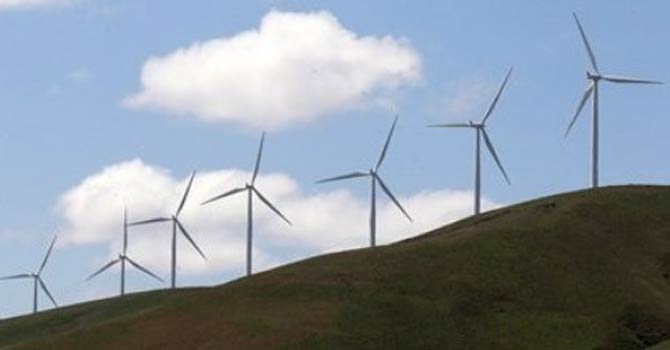
LONDON: Large wind farms might have a warming effect on the local climate, research in the United States showed on Sunday, casting a shadow over the long-term sustainability of wind power.
Carbon dioxide and other greenhouse gases from burning fossil fuels contribute to global warming, which could lead to the melting of glaciers, sea level rise, ocean acidification, crop failure and other devastating effects, scientists say.
In a move to cut such emissions, many nations are moving towards cleaner energy sources such as wind power.
The world’s wind farms last year had the capacity to produce 238 gigawatt of electricity at any one time. That was a 21 per cent rise on 2010 and capacity is expected to reach nearly 500 gigawatt by the end of 2016 as more, and bigger, farms spring up, according to the Global Wind Energy Council.
Researchers at the State University of New York at Albany analysed the satellite data of areas around large wind farms in Texas, where four of the world’s largest farms are located, over the period 2003 to 2011.
The results, published in the journal Nature Climate Change, showed a warming trend of up to 0.72 degrees Celsius per decade in areas over the farms, compared with nearby regions without the farms.
“We attribute this warming primarily to wind farms,” the study said. The temperature change could be due to the effects of the energy expelled by farms and the movement and turbulence generated by turbine rotors, it said.
“These changes, if spatially large enough, may have noticeable impacts on local to regional weather and climate,” the authors said.
More research needed
But the researchers said more studies were needed, at different locations and for longer periods, before any firm conclusions could be drawn.
Scientists say the world’s average temperature has warmed by about 0.8 degrees Celsius since 1900, and nearly 0.2 degrees per decade since 1979. Efforts to cut carbon dioxide and other greenhouse gas emissions are not seen as sufficient to stop the planet heating up beyond 2 degrees C this century, a threshold scientists say risks an unstable climate in which weather extremes are common.
The Texas study found the temperature around wind farms rose more at night, compared with nearby regions. This was possibly because while the earth usually cools after the sun sets, bringing the air temperature down, the turbulence produced by the farms kept the ground in their area warm.
Previous research in 2010 by other US scientists found wind farms could make the nights warmer and days cooler in their immediate vicinity, but those effects could be minimised by changing turbines’ rotor design or by building the farms in areas with high natural turbulence.
That research was based on evidence from two meteorological towers over a six-week period.
Although the warming effect shown in that study and the latest research is local, and small compared to overall land surface temperature change, the findings could lead to more in-depth studies.
The authors of the study released on Sunday said: “Given the present installed (wind farm) capacity and the projected installation across the world, this study draws attention to an important issue that requires further investigation.”
“We need to better understand the system with observations and better describe and model the complex processes involved to predict how wind farms may affect future weather and climate.”
Commenting on the study, Steven Sherwood, co-director of the Climate Change Research Centre at the University of New South Wales in Australia, said: “Daytime temperatures do not appear to be affected. This makes sense, since at night the ground becomes much cooler than the air just a few hundred metres above the surface. The wind farms generate gentle turbulence near the ground that causes these to mix together, thus the ground doesn’t get quite as cool.”


























