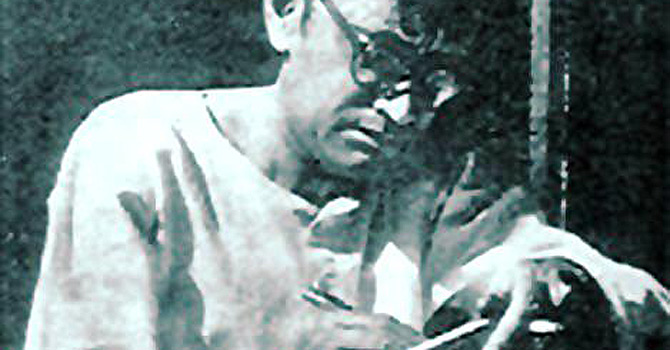
May 11, 2012 marks Sadat Hasan Manto's birth centenary. To Celebrate the occasion Books&Authors invited some of the most well-known names of Urdu literature to share their thoughts on a writer Zaheda Hina terms the “creative conscience of the subcontinent”.
In this part of the discussion panelists try and understand what makes Manto different from fellow writers who were addressing similar themes.
Wusatullah Khan (WK) A lot of Manto’s contemporaries were writing on the same subjects Manto wrote on. How is Manto standing apart from them as a short story writer?
Mohammad Ali Siddiqui (MAS) Manto stands apart only at one point and no one is comparable to him on that. He ridiculed the values and the taboos society holds dear and said that they are wrong. Whether you are Hindu or Christian, they are wrong. His religion was humanity. He was neither Muslim nor Christian or Hindu or Sikh. Later, Fateh Mohammed Malik Sahib made him Muslim and Pakistani, which I think was wrong.
Manto’s greatest contribution is that in a society where humanity was divided in religions, he ended that division. And he sympathised with those with whom people were not sympathising, the down-trodden. He saw humanity in everyone.
Zaheda Hina (ZH) Manto internalised the pain of Partition, not as a Muslim, Hindu or Sikh or as a speaker of Urdu, Punjabi or Marathi but as a human being, and was shattered in the process.
Partition was a season of arson, bloodbath, kidnapping, rape and the destruction of cities and citizens. It was like an earthquake which brought down all the moral values and human relationships in the subcontinent. Most of the short story writers of that era wrote on this savagery and barbarism, such as Krishan Chander, Rajinder Singh Bedi, Ahmed Nadeem Qasmi, Ismat Chughtai, Khadija Mastoor. But there is no greater chronicler of this human tragedy than Manto.
If Manto stands out among the short story writers of that time, it is because he was against any partition of the subcontinent on the basis of religion. He failed to understand how culture, civilisation, art, music, dance and architecture could be partitioned. Perhaps that is why he could write a great story like “Toba Tek Singh”.
Most of our writers used to exercise great caution when they wrote about the tragedy of Partition lest they be labelled Hindu, Sikh or Muslim. Manto, however, never cared about the opinions his writings would generate. He would even fight God himself against the injustices in this world. Lamenting the fall of humanity, he wrote: “Don’t say that a hundred thousand Hindus and a hundred thousand Muslims have been massacred. Say that two hundred thousand human beings have been slaughtered. And it is not such a great tragedy that two hundred thousand human beings have been butchered but the real tragedy is that the dead have been killed for nothing. After killing one hundred thousand Hindus, Muslims must be thinking that the Hindu religion is dead, but it is alive and will live on. Likewise, after murdering a hundred thousand Muslims, Hindus must be rejoicing that Islam is finished, but the reality is in front of you. Only idiots can think that religions can be hunted down by guns.”
The Mahabharat of Partition was written on the body of the hapless and helpless women of all religions of the subcontinent. Muslims, Hindus and Sikhs, all can see the images of their own savagery and barbarism in Manto’s ruthless writings. “Khol Do”, “Thanda Gosht”, “Woh Larki”, “Mozail”, “Sahaey”, “Ram Khilawan”, and “Gormukh Singh ki Wasiyat” are stories which put many questions to our collective conscience. Manto has been rightfully called the creative conscience of the subcontinent.
Fahmida Riaz (FR) Manto stands apart from other writers because there is no ambiguity in his message. He conveys it to the reader directly and forcefully, hitting the nail on the head, as one says. Besides, indeed all his contemporary writers, such as Krishan Chander, Ismat Chughtai, Rajinder Singh Bedi, Khwaja Ahmad Abbas also had very individual styles. It was quite a galaxy of writers in those days. But Manto had to suffer much more than others for his literary creations. That too sets him apart.