0
0

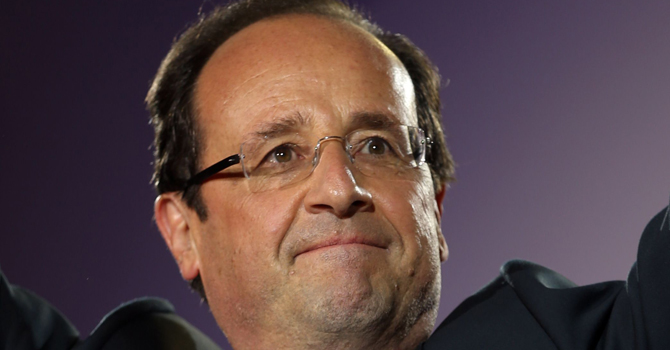
BRUSSELS: After slamming Europe's austerity fix for the debt crisis, Francois Hollande's crusade for growth picked up support even before his win, but can he bring the sceptics and the markets around?
One of only a handful of Socialist leaders at the European Union table, the freshly-elected French president said his victory marked “a new departure for Europe and hope for the world” because it showed “austerity can no longer be the only option.”
As unemployment hits its highest level ever in Europe since the creation of the euro, Hollande's campaign calls to rewrite a just-inked and long-negotiated EU fiscal pact to enforce budgetary discipline is causing jitters on markets and ruffling German Chancellor Angela Merkel.
“There is real potential for friction,” said analyst Maurice Fraser from Chatham House think-tank.
“Can they change the wording, will he be happy with a vague shift?” he said of the pact agreed by 25 of the EU-27 on terms largely shoved through by Merkel and her French ally, outgoing incumbent Nicolas Sarkozy.
“These issues will take a long time to negotiate with Germany,” Fraser added.
“But the Franco-German motor will need to demonstrate the show is not coming apart. They might have been high-handed but at least they looked like credible European leaders.”
Seeking to soothe fears of a breakdown in the Franco-German motor that drove Europe through the crisis, German Foreign Minister Guido Westerwelle said after Hollande's victory: “We will work together on a growth pact”.
“I have no doubt that we will rise to our common challenges,” he added.
But as austerity fatigue sets in across the continent, driving far-right gains both in France and Greece, Hollande's call for a switch of focus has found wide support, from French voters, from the European Commission and even perhaps to an extent from the man in charge of eurozone monetary policy, European Central Bank chief Mario Draghi.
Hollande however faces parliamentary elections as quickly as mid-June, just before an EU summit, and will need to show his electorate he can deliver.
Meanwhile Spain has cashflow trouble, Italy is fighting to stay afloat and an under-performing France—already facing lengthening jobless queues and growing disparity with Germany—has been threatened with a ratings downgrade in the wake of an Hollande victory.
So much speculation touches on whether the new leader of the world's fifth economy—Europe's second—will hugely disrupt EU and eurozone politics with his calls for a swing to growth-friendly policies.
“Europe should have no real reason to fear his victory,” said analyst Thomas Klau of the European Council on Foreign Relations, after The Economist labelled him “the rather dangerous Monsieur Hollande.”
The new French leader, a pro-European said to have arch European federalist Jacques Delors as his mentor, “is a natural compromise-builder”, Klau said.
“Hollande is far more predictable than Sarkozy, who was a man of his own, a little bit all over the place,” said a senior EU diplomat.
Hollande has four initial demands of the EU: he wants more money in the European Investment Bank, a new financial transactions tax, new EU bonds to fund large job-creating infrastructure projects and the use of unspent EU funds to spur growth.
All four are already in the EU executive pipeline, though facing varying degrees of opposition from various quarters, notably Britain and Germany.
Hollande “seems inert but might change the face of the EU,” said Hugo Brady of the Centre for European Reform in Brussels.
“Because a lot more is needed than the fiscal compact to save the single currency it will be easier for Hollande to present himself as the spokesman for the disenchanted of the crisis,” he said.
As one of the main papers in the EU capital put it this weekend, referring to Europe's economic, political and moral crisis: “Will France save Europe?”
But despite his pro-European credentials, others see Hollande fighting in the main to keep national interests to the fore.
“It's an exaggeration that we'll see a more pro-European France, that under a Socialist, France would be more community-oriented,” said Fraser.
“France will continue to act robustly in its own interests, though the language might change.”