0
0

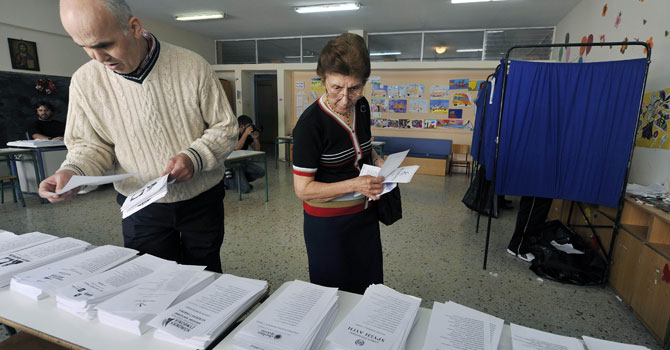
ATHENS: Greece stared into a chasm of uncertainty Monday after a stunning election shake-up by parties opposed to further austerity cuts, sending shockwaves through markets on fears of renewed eurozone turmoil.
Results of Sunday's elections showed that the two mainstream parties missed an absolute majority in parliament after their share of the vote was 32.1 per cent — more than halved from 2009 election — plunging the country into political uncertainty.
Instead, voters angry after two years of cuts handed parties against the terms of Greece's two international bailouts a stunning result — a total of 151 parliamentary seats between them, based on 99 per cent of votes counted.
The shock outcome throws Greece into disarray since top vote-getter Antonis Samaras of the New Democracy conservatives will find it very hard to form a government — once he is officially tasked to do so by the president later Monday.
Athens has already committed to finding in June another 11.5 billion euros in savings over the next two years.
Since left-wing Pasok and New Democracy, which formed the outgoing coalition led by technocrat Prime Minister Lucas Papademos, will not have a legislative majority, the possibility now looms of fresh elections.
Pasok, which along with New Democracy has dominated Greek politics for nearly four decades, was even relegated to third place by the leftist Syriza, which more than tripled its share of the vote from 2009 to 16.7 per cent.
“The parties that signed the memorandum (with the EU and the IMF) are now a minority. The public verdict has de-legitimised them,” Syriza head Alexis Tsipras said late Sunday, calling the election a “message of overthrow”.
In total seven parties were set to enter parliament compared with five after the last election.
Neo-Nazi party Golden Dawn was also set to enter parliament for the first time since the end of the military junta in 1974, with 6.5-7.5 per cent of the vote, making it the sixth-biggest party in the 300-seat chamber with some 20 lawmakers.
Leader Nikos Michaloliakos said his party would fight against “world usurers” and the “slavery” of an EU-IMF loan agreement he likened to a “dictatorship”.
“The time for fear has come,” he said.
Independent Greeks, a new right-wing party set up by New Democracy dissident Panos Kammenos, is slated to become the fourth-biggest party with 33 seats followed by the communist KKE with 26 lawmakers.
The Democratic Left, a Europhile new leftist party, will hold 19 seats in the new-look chamber.
Both Pasok and ND have said they want the “troika” of the European Union, International Monetary Fund and European Central Bank to cut Greece more slack in their two bailout deals worth 240 billion euros.
But with voters angry at the painful austerity cuts demanded in response, many of the smaller parties, including possible kingmaker Syriza, want to tear up the agreements.
The communist KKE party wants to leave the eurozone and the neo-Nazis say they want to stop servicing Greece's debts, an aim shared by Kammenos who advocates turning to Russia to prop up the country.
Panayotis Petrakis, economics professor at Athens University, expressed hope however that new French president-elect Francois Hollande “would prevent Europe treating us too harshly. There is still a little room for manoeuvre.”
Petrakis told AFP that the most likely outcome was another “government of technocrats” headed again by outgoing premier Papademos, or fresh elections.
The result, plus the victory of the left-wing Hollande, sent the euro lower in Asian trading, dipping at one stage to $1.2954, its weakest level since late January, while also slumping to 103.22 yen.
Japan's top government spokesman said Tokyo will “carefully monitor” how Europe reacts to the French election.
“The trajectory of the European economy greatly affects our economy,” Chief Cabinet Secretary Osamu Fujimura told reporters, adding that Japan considered discussions between France and European powerhouse Germany “important”.
Stocks on the DAX index in eurozone paymaster Germany plunged 2.2 per cent while France's stock market slid 1.57 per cent. Greece stocks plunged 7.6 per cent in early trade.