0
0

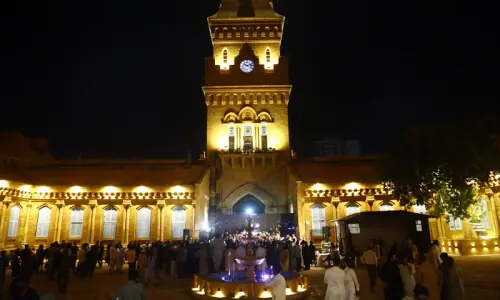
KARACHI, May 11: Scholars discussed the life and works of Saadat Hasan Manto at a seminar organised to celebrate his birth centenary at the Arts Council on Friday.
Asad Mohammad Khan, who presided over the event, said when he was in school (class IX) a Progressive Writers’ Conference was held in his native city. He went there in the hope that Manto would also be a participant in the moot. It was not to be. Then he came to know that some people and a certain group of writers were not happy with Manto because of the kind of stories that he had penned.
At that point, Mr Khan argued that lack of wisdom (jahl) was like a disease; but it was of a transient nature. Today every city in the country was holding a programme where Manto lovers could be seen in big numbers. He said though it had been more than 60 years since his death, his works were still being read and studied. He added that writers like him had entered the 21st century because of Manto.
Masood Ashaar went down memory lane and narrated an incident when Manto was invited to the Government College to talk about his writings. There Ahmed Rahi recited Raja Mehdi Ali Khan’s poem that he had written on Manto.
Mr Ashaar said Manto was a writer who broke many taboos and with respect to the issue of sex he could be bracketed with D.H. Lawrence.
However, he argued, people often ignored the way the writer had unmasked violence in society. In that regard, he gave the examples of Anthony Burgess’ novel ‘A Clockwork Orange’ and a Hollywood film ‘Bonnie and Clyde’, which were considered pioneer in unveiling the horrors of violence through literature and art in the 1960s. But, he said, Manto had touched on the subject way back in the 1940s.
He said that Manto was a misfit and rebel. He was a misfit in Mumbai and no different after migrating to Lahore. Misfits, he remarked, chose a different path for themselves. Mr Ashaar told the audience that he had seen Manto after partition and had always found him in haste — he was a disturbed soul. He claimed the writer’s alcoholism did not kill him. What killed him was his state of disconsolateness. If he had been alive, he would have been more perturbed seeing what Pakistan had become, he added.
Media person Farhad Zaidi shared a very interesting incident with the gathering. He said when he was in Lahore he used to meet Manto at a famous shop, owned by Mohammad Tufail. One day Manto said he was the best short story writer in the subcontinent and to provide evidence for that asked him (Zaidi) to write anything on his writing pad and he would turn it into a story. After a bit of humming and hawing, Mr Zaidi wrote ‘Us larki ke jism mein mujhe us ki aankhein sub se zayada pasand theen’ (What I liked best about that girl was her eyes). Manto thought for a minute and in the next 35 minutes composed a short story based on that line. Its title was ‘Aankhein’. Later on the writer told Mr Zaidi that he had put him in a spot of bother because he had never written a story in the first person singular.
Writer Zaheda Hina said partition of the subcontinent was more devastating than anything that could be recorded on the Richter scale.
She said Manto did not link oppression (zulm) with religion or ethnicity — his argument was with God. She said the writer painted a veritable picture of the oppressed segments of society, including women, which was why even he wrote about prostitutes in his stories he did not show them as neat and clean individuals but as they actually were.
She maintained that following his arrival in Pakistan what Manto saw of a country created in the name of religion upset him. It was during that time that he produced a story such as ‘Khuda Ki Qasam’. She concluded even if we had read Manto (the way he deserved to be read) before 1970, we would not have to witness another partition.
Asif Farrukhi started off by reading a line by Ghalib ‘Eid-i-nazzara hai shamsheer ka uryan hona’ and likened Manto’s stories to it. He subtly criticised the way the writer was being treated in contemporary times where Manto was taken out of Manto stories. He talked about the gradual but effective evolution of the narrative in his tales that enabled him to come up with sharp and meaningful pieces such as ‘Kaali Shalwar’.
He wound up his speech by saying that no critic could lessen the value of the eminent writer.
Mobin Mirza said Manto was the first rebel in Urdu fiction. Like all great writers, he was a nonconformist.
Saeed Khawar read out a conceptual paper on the writer.
Ambreen Haseeb Amber, who anchored the event, discussed the brutal honesty with which Manto wrote.
Journalist Wusutullah Khan read out a poignant paper in the form of a letter that Manto had written to him.