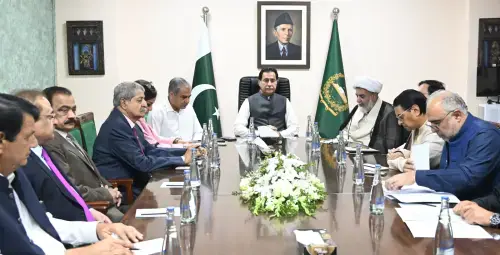
RAWALPINDI: Top military commanders of Pakistan, Afghanistan and the International Security Assistance Force (Isaf) met here on Sunday and shared ideas on establishing a credible communication and coordination mechanism to obviate recurrence of Salala-like incidents that seriously affected Pakistan-US relations and also strained Islamabad’s ties with Kabul.
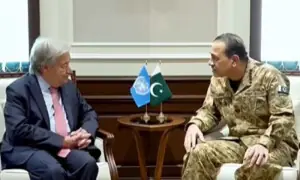
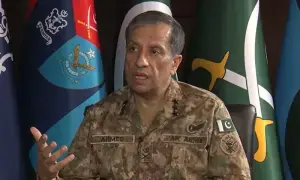
Chief of Army Staff General Ashfaq Parvez Kayani, Afghan military chief General Sher Mohammad Karimi and Isaf Commander General John Allen led their sides at a meeting of the Tripartite Commission.
“The talks focused on border control measures and mechanisms put in place to avoid untoward incidents on both sides of Pakistan-Afghanistan border,” a press release issued by the Inter-Services Public Relations said.
It was the first meeting of the commission which is a forum to raise and process contentious issues and facilitate settlement since the Nato attack on two military checkposts in Mohmand Agency in November 2011, leaving around two dozen Pakistan troops dead.
Sources told Dawn that the Pakistani side briefed the meeting on the steps taken by it to control transportation of material which could be used to manufacture improvised explosive devices and proposed measures to curb the menace on the other side of the border.
Pakistan has rejected as baseless claims that the attack on the checkposts was a result of misunderstanding. The attack led to stopping of Nato supplies. Relations with Afghanistan were also strained because its territory had been used for the attack.
The commission’s meeting took place a day after the Isaf commander had held a meeting with General Kayani and two days after Nato Secretary General Andres Fogh Rasmussen hinted that Pakistan could miss out on the Nato summit to be held in Chicago on May 21-22 if it did not reopen Nato supply lines.
A set of recommendations on new terms of engagement with the US and Nato were prepared by the Parliamentary Committee on National Security and presented to parliament. The parliament has set various conditions for reopening Nato supply routes.
The issue is also expected to top the agenda of a meeting of the Defence Committee of the Cabinet on Tuesday.
After the 6th core group meeting of the three countries last month during the visit of US Special Envoy for Pakistan and Afghanistan Marc Grossman, Foreign Secretary Jalil Abbas Jilani had announced that Islamabad, Washington and Kabul had agreed to provide ‘safe passage’ to Taliban militants willing to join reconciliation talks and set up a working group to settle modalities for their unhindered movement.
The move that had come in conjunction with the three sides agreeing to coordinate their activities at the UN for removing Taliban leaders from the sanctions list of the Security Council was considered to be the biggest step forward for promoting reconciliation in Afghanistan since the core group was established a year ago for the sole purpose of advancing the peace process.
Moreover, the announcement came weeks ahead of the Nato summit in Chicago, which would review military efforts in Afghanistan and take stock of progress towards reconciliation.
The two steps were seen as a confidence-building move to put back on track the reconciliation process which had suffered a setback last month with the Taliban pulling out of the Qatar process.
AFP adds: US General John Allen said he was “very encouraged” by the talks.
“There was agreement these meetings are important to achieving continued progress towards... a peaceful Afghanistan so that Afghanistan can no longer be a safe haven for terrorists,” Mr Allen said, according to an ISAF statement.