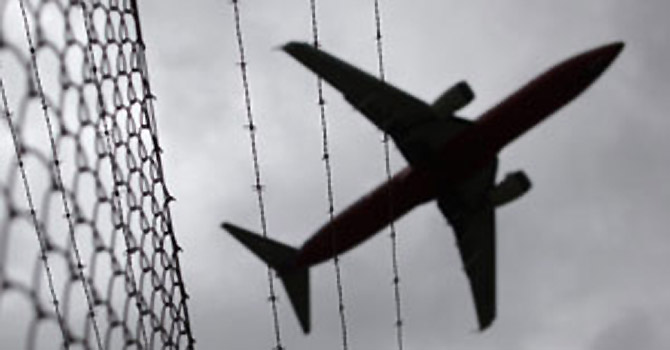
SEOUL: North Korea has stopped transmitting signals which jammed the GPS systems of hundreds of civilian aircraft and ships in South Korea for two weeks, officials said Tuesday.
The state Korea Communications Commission said the signals designed to jam global positioning systems halted as of 8:34pm on Sunday.
The transport ministry confirmed civilian flights had not been affected since Sunday night.
South Korean officials said the signals originated from the North's border city of Kaesong and began on April 28, forcing sea and air traffic to use other navigational equipment to avoid compromising safety.
The reason for the jamming, which the North has not admitted, was unclear but it came at a time of high cross-border tensions.
The North has threatened “sacred war” against the South in retaliation for perceived insults during Pyongyang's commemoration in April of the centenary of the birth of founding leader Kim Il-Sung.
The North has twice before been accused by Seoul of jamming GPS systems but there was no previous widespread effect on civilian flights.
The latest exercise may have been intended to “test electronic warfare devices by the North Korean military or block mobile phone signals inside the North”, said a South Korean military official quoted by Yonhap news agency.
The reason why the jamming was apparently stopped was also unclear.
South Korean President Lee Myung-Bak discussed the issue Monday in talks in Beijing with Chinese President Hu Jintao, Lee's office said. “China seemed to be surprised when our side gave a full explanation of North Korea's attack,” presidential security aide Kim Tae-Hyo told Yonhap.
China is the North’s sole major ally and provides vital economic support.
“North Korea probably stopped its attack because it was not so effective and failed to cause any substantial damage to our systems,” a Korea Communications Commission official told AFP on condition of anonymity.
South Korea complained about the jamming to Pyongyang and to the International Telecommunication Union and International Civil Aviation Organisation.
Baek Seung-Joo, of the Korea Institute for Defence Analyses, said: “I think the regime might have taken international criticism into consideration in its decision-making. Such an attack on civilian aircraft is outrageous and dangerous.”
The signals affected the GPS systems of aircraft using Seoul’s Incheon and Gimpo airports and those flying over the central part of the Korean peninsula.
Official data showed about 670 flights, mostly operated by South Korean carriers, had reported disruption to GPS signals up until May 10.
The South previously accused the North of broadcasting jamming signals in March last year and August 2010.