While they may project an aura of opulence during their visits back home, their life in Canada, however, is often full of struggle and frustration. Thousands of Pakistani trained engineers, doctors, and PhDs are driving taxis or are working as security guards in large cities. In fact, one in three taxi-drivers in Canada was born in either India or Pakistan. Several others are unemployed thus becoming a burden on Canadian taxpayers.
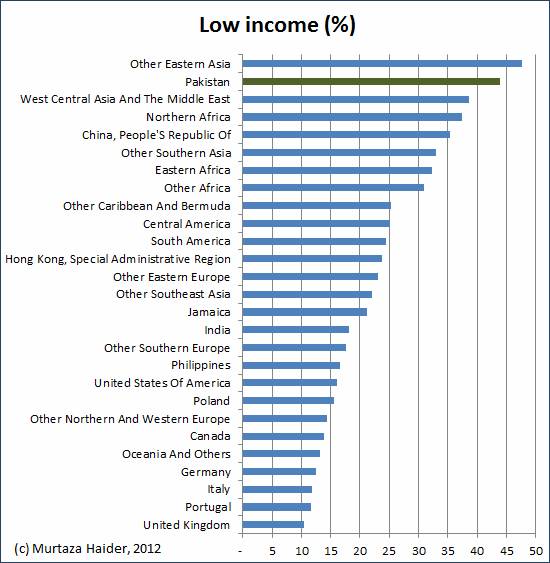
The latest Census data for income for 2005 revealed that Pakistan-born immigrants reported the second highest incidence for the low-income cut-off, a proxy for poverty line in Canada. In comparison, only 18 per cent of India-born immigrants in Canada reported being a low-income person or belonging to a low-income economic family. Immigrants born in the United Kingdom, Portugal, Italy and Germany reported the lowest incidence of poverty in Canada.
Unlike in the Middle East where the Arab governments do not allow assimilation of migrant workers, the Canadian government and the society to a large extent does not create systematic barriers that may limit the immigrants’ ability to succeed and assimilate in Canada. This is not to suggest that immigrants face no barriers at all in Canada. They in fact do. For instance, Pakistan-trained doctors cannot practice medicine without completing further training in Canada. The shorter duration of medical training in Pakistan necessitates the additional certification for doctors. Engineering graduates from Pakistan, however, face no such barrier because the engineering curriculum and the duration of training in Pakistan is similar to that in Canada.
Despite the opportunities (and constraints), Pakistani-Canadians have not prospered as much as immigrants from other countries have. In 2005, wages earned by Pakistan-born immigrants were on average 70 per cent of the wages earned by those born in Canada. In comparison, wages earned by the India-born immigrants were 86 per cent of the wages earned by Canadians. At the same time, immigrants born in America earned 20 per cent more in wages than those born in Canada. Similarly, UK-born immigrants also reported on average higher wages than that of Canadian-born.

Because of lower wages, the Pakistan-born immigrants reported as one of the lowest home-ownership rates. Only 55 per cent of Pakistan-born immigrants reported owning their homes. In comparison, 75 per cent of the India-born immigrants owned their homes. At the same time, while only 12 per cent of the India- and Philippines-born immigrants had never worked in the past, 22 per cent of the Pakistan-born immigrants in Canada reported never being in the workforce.
The difference in wages, home-ownership rates, and employment rates between immigrants from India and Pakistan extend beyond the economic spheres. For instance, Pakistani-born immigrants live in large-sized families. Whereas only 13 per cent of India-born immigrants live in households of five persons or more, 44 per cent of the Pakistan-born immigrants live in households with five or more people. Given the lower wages, high unemployment rates and rental units, Pakistan-born immigrants experience severe crowding at homes where the number of residents per room is perhaps the highest owing to the large family sizes.
Given similar cultural endowments, education, and language skills, it is important to explore why Pakistan-born immigrants in Canada have lagged behind their Indian counterparts. The Indian diaspora is much larger in size and has been established in Canada for over a longer period, which has allowed immigrants from India to benefit from the social networks required to establish oneself in employment markets.
While immigrants from Pakistan lack the social networks necessary for success with employment, I would also argue that they suffer from a self-imposed identity crisis. After arriving from Pakistan, many male immigrants feel threatened by the Canadian liberal values, which empower their children and women. Suddenly the head of the household cannot dictate the way he did in Pakistan. Instead of embracing the change that empowers their families, several male immigrants end up in a hostile standoff with their families that sometimes lasts for decades. At the same time, religious leaders, which are almost always imported from back home to serve in mosques in Canada, preach orthodoxy to the parish, further confusing the struggling males.
With turmoil at home and bleak employment prospects outside, Pakistan-born male immigrants struggle with the decision to stay in Canada or return to Pakistan. Children and wives are often shipped back to Pakistan for prolonged periods while the males continue struggling in the job market. While their children see themselves as Canadians, the Pakistan-born male immigrants spent decades figuring out how to cope with their hyphenated identity, i.e., Pakistani-Canadian.
The limited success of (mostly Asian and African) immigrants in the economic spheres and their modest assimilation in the mainstream Canadian culture has prompted the right-wing groups to launch campaigns against immigration to Canada. While opponents of immigration are mostly naïve and their recommendations to reduce immigration border on lunacy, the fact remains that huge changes in the Canadian immigration policies are already taking place. In Saskatchewan, for instance, the provincial government on May 2 has changed the law that now prohibits immigrants from sponsoring their extended family members unless they secure a “high skill” job offer before arrival.
Since 2001, Pakistan has lost the most in its share of supplying immigrants to Canada. Pakistan was the third largest source of immigrants to Canada in 2001 supplying 6.1 per cent of the total immigrants. However, by 2010 Pakistan’s share of immigrants declined by 71 per cent. Pakistan is no longer even in the top 10 sources of immigrants for Canada. At the same time, the Philippines experienced a 153 per cent increase in its share of immigrants making it the biggest source of immigrants to Canada in 2010.

While there is no shortage of applicants in Pakistan, it is hard to establish the precise reason for the declining number of immigrants. It could be that the dismal performance of Pakistan-based immigrants may have prompted the government to reduce the intake from Pakistan. It may also be true that the exponential increase in violence and militancy in Pakistan may have made the task of verifying credentials and identifying future citizens much more difficult.
Over the next 50 years Canada will need millions more immigrants. The current and expected fertility rates in Canada suggest that immigration is the only possible way of ensuring enough workers needed for economic growth and to keep solvent Canada’s security net. Pakistan-born immigrants had the chance to excel in Canada and pave the way for future generations of enterprising immigrants. Instead, Pakistan-born immigrants became the face of Canada’s urban poverty. Their dismal performance in Canada and the spread of religious fanaticism back home will most likely further reduce immigration from Pakistan.

The views expressed by this blogger and in the following reader comments do not necessarily reflect the views and policies of the Dawn Media Group.