5
5

NOW I’ve heard everything. When the power situation hit the high water mark one more time, the government rolled out another one of its horse and cattle shows, complete with ‘briefings’ from the ministries and ‘proposals’ from the bureaucracy.
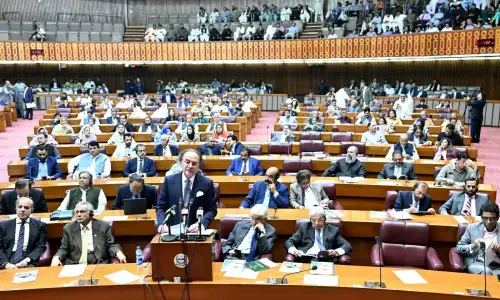
A two-day long, full court affair in the capital, in which ministers from Petroleum and Water and Power and Finance all sat around a table in the presidency, concluded on Tuesday on a note that probably none of them came prepared for.
Unless the presidential spokesman, the venerable Senator Farhatullah Babar has been misquoted, it went something like this.
They will set up a ‘control room’ in the Ministry of Water and Power, from where they will be able to personally monitor the generation of electricity at power plants around the country, its transmission to the distribution companies, and those areas where loadshedding is being carried out.
And the best part: the ‘control room’ will have its counterpart in the presidency, so the president himself will be able to see how much electricity is being produced, who’s getting it and who isn’t.
Don’t bother asking what they will do with this information. Somebody up there actually thinks that the distribution of electricity is something like the distribution of sacrificial meat amongst the poor. ‘Give him some, that one over there, he’s been waiting for a long time. No, not this one here, he’s had some already and keeps coming back for more. That one over there, he’s pushing and shoving too much! Tell him to stop otherwise he’ll get none!’
It’s a landlord’s way of managing scarcity, if you think about it. If you want to understand how this government is going about managing the energy crisis, just look at how irrigation water is managed and you’ll get the perfect metaphor.
The large landlord will own the choicest land right next to the canal headworks. When the water is released he will take all that he needs and then some, and whatever is left can flow downstream until it reaches the poor ‘tail-enders’ who will then fight for the trickle that is left for them.
Something very similar happens in the management of all public goods in the agriculture sector.
Whenever wheat procurement gets under way, for instance, the big guy will get the red carpet treatment while the little guy gets the bureaucratic run-around at the procurement centre. Or with fertiliser, where the distribution of imported fertiliser, which is entirely government-owned, has been handed over to a couple of political families who decide who gets how much and who is left out in the cold.
In short, a privileged strata gets priority access to the public goods owned by the government, and only when their needs, and the needs of those connected with them, have been met will the rest of us get what’s left.
Now something similar is being done with electricity. The recently concluded meeting was preceded by April’s ‘energy conference’, the third such conference held by this government in four years.
The big agreement to come out of that conference was that the burden of loadshedding will be borne equitably by all the provinces. It’s hard to claim that that commitment has been upheld.
And before that, in October, another such full-day affair had ended with a commitment that there will be “no more sacred cows in the matter of bill recoveries”.
Between November and February, an effort of sorts was indeed launched to get outstanding bills recovered, during which a list was presented to the National Assembly of the big parties who had large outstanding electricity dues — a very long list consisting mostly of government offices.
So this time around, did the assembled delegates of the meeting make any attempt to tally up their successes in the previous commitments? No. In fact, the question of aggressively going after defaulters didn’t even arise this time, nor did the question of determining and measuring provincial entitlements to electricity.
In fact, the only thing the presidential spokesman felt comfortable talking about after the meeting was the rather bizarre proposal for the president and the minister of water and power to personally monitor the allocation of electricity around the country.
What’s clear is this: the government is no longer even pretending to resolve the issues in the power sector. At least the earlier such gatherings made some of the right noises afterwards. This time the only concrete suggestion to come out of the whole affair is one that expands the sway of arbitrary authority in crucial power-sector decisions.
If the government is at all serious about this proposal to build a ‘control room’ to monitor the generation and distribution of electricity across the country, and we see real work take place to actually install such a facility in the presidency, then we will know beyond a shadow of a doubt that politics has triumphed over policy.
The management of scarce public goods reveals a great deal about whether or not a given dispensation is capable of addressing the challenges facing the country.
In some cases, growing scarcities prompt reforms that seek to increase supply and encourage judicious use of a dwindling public good. But in the case of Pakistan, scarcities in public goods have been managed by creating a steeply hierarchical entitlement regime, then using those hierarchies to trade loyalty for access.
If you have cultivated the right kinds of links with the right networks over time, you will have privileged access to irrigation water or bank credit or natural gas or any other public good.
Now it looks increasingly as if this is what the government is moving to entrench in the power sector: a hierarchical entitlement regime rather than reforms that aim to increase efficiencies and promote investment.
The writer is a Karachi-based journalist covering business and economic policy.
Twitter: @khurramhusain
khurram.husain@gmail.com