0
0

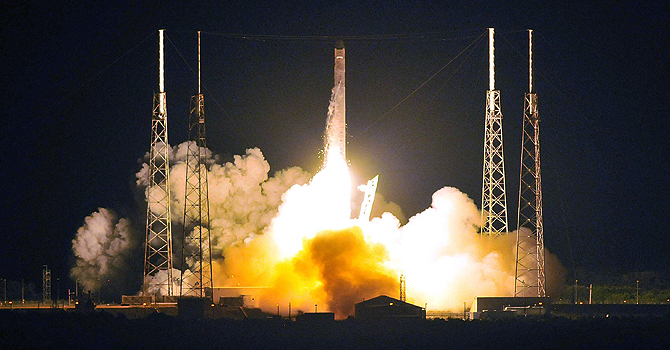
CAPE CANAVERAL: An unmanned rocket owned by privately held Space Exploration Technologies blasted off from Cape Canaveral Air Force Station on Tuesday on the first commercial flight to the International Space Station.
The 178-foot (54-meter) tall Falcon 9 rocket lifted off at 3:44 a.m. from a refurbished launch pad just south of where NASA launched its now-retired space shuttles.
Less than 10 minutes later, the rocket delivered its cargo — a Dragon capsule with 1,200 pounds (544 kg) of supplies for the station crew — into orbit.
“Feels like a giant weight just came off my back,” company founder and chief executive Elon Musk posted on Twitter after Dragon deployed its solar panels, the first of several key milestones that must be met before the spacecraft is cleared to dock at the station. “Every launch into space is a thrilling event, but this one is especially exciting because it represents the potential of a new era in American spaceflight,” John Holdren, President Barack Obama's chief science adviser, said in a statement.
NASA is counting on companies like Space Exploration Technologies, or SpaceX, to take over the task of flying cargo — and eventually astronauts — to the $100 billion space station, which orbits about 240 miles above Earth.
Currently, NASA is dependent on Russia to fly crew to the station, at a cost of more than $60 million per person. Russia, Europe and Japan also fly cargo to the station.
If its test flight is successful, SpaceX would become the first private company to reach the space station, a microgravity research complex for biological, materials, fluid physics and other science experiments and technology demonstrations.
The Aerospace Industries Association said the launch was a milestone for U.S. space flight and showed how collaborative investments by government and industry could help the United States remain an important player in space.
“Continuing collaborative investments in NASA's commercial crew program will be crucial to ending our dependence on Russia for astronaut launch,” said AIA President Marion Blakey. “This launch, along with other investments NASA and industry are making, shows that our nation still has the right stuff.” SpaceX and a second company, Orbital Sciences Corp, already hold contracts worth a combined $3.5 billion to fly cargo to the station.
SpaceX also is among four firms vying to build space taxis to fly astronauts, tourists and non-NASA researchers.
Separately, NASA contributed nearly $400 million to SpaceX's $1.2 billion commercial space program, which includes development and up to three test flights of Falcon 9 rockets and Dragon capsules.