0
0

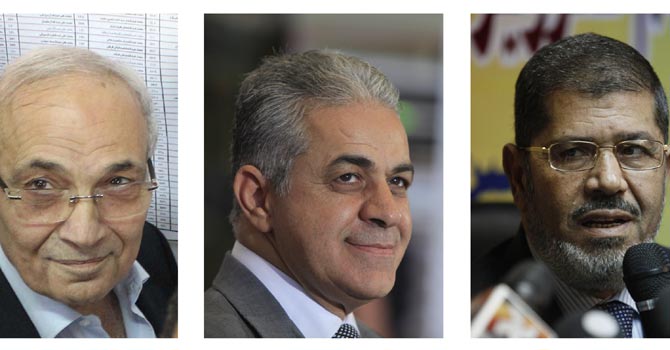
CAIRO: The candidate of Egypt's Muslim Brotherhood won a spot in a runoff election, likely against a veteran of ousted leader Hosni Mubarak's regime in what would be a deeply divisive battle to become the new president of Egypt, according to partial results Friday from the first round of voting.
The runoff will be held on June 16-17, pitting the two top contenders from the first round of voting held Wednesday and Thursday. The victor is to be announced June 21.
Nearly complete results showed the Brotherhood's Mohammed Morsi rising into the second round with a plurality of the votes. Former prime minister Ahmed Shafiq appeared headed into the second round as well, though it was not entirely certain.
A dark horse leftist candidate was close on his tail for the spot, and still-uncounted votes from the country's biggest metropolis, the capital Cairo and its sister city Giza, gave him at least a theoretical chance to overtake Shafiq.
Morsi and Shafiq are the country's most polarizing candidates, each loathed by significant sectors of the population. A head-to-head match between them is the most heated imaginable scenario, ironically, recreating the pattern of the past three decades, when the Brotherhood was the Mubarak regime's top opponent.
The Brotherhood, which already dominates parliament, has promised to implement Islamic law in Egypt, alarming moderate Muslims, secular Egyptians and the Christian minority who fear restrictions on many rights.
Morsi's first place win was based on the Brotherhood's ability to bring out its fiercely loyal base. But he garnered less than half the vote that the Brotherhood raked in during parliament elections late last year, a sign of public disenchantment with the group.
Shafiq's strong showing, in turn, would have been inconceivable a year ago amid the public's anti-regime fervor. He was Mubarak's last prime minister and was himself forced out of office by protests several weeks after his former boss was ousted.
A former air force commander and personal friend of Mubarak, he campaigned overtly as an ''anti-revolution'' candidate in the presidential election, criticizing the anti-Mubarak protesters. He still inspires venom of many who believe he will preserve the Mubarak-style autocracy that the popular revolt sought to uproot. He has been met at public appearances by protesters throwing shoes.
But his rise underlines the frustration with the revolution felt by many Egyptians. The past 15 months have seen continuous chaos, with a shipwrecked economy, a breakdown in public services, increasing crime and persistent protests that turned into bloody riots. That has left many craving stability.
In a runoff, the Brotherhood will likely try to drum up anti-Mubarak fervor among the public, while Shafiq will play on fears of an Islamist takeover.
Each has repeatedly spoken of the danger if the other becomes president. Morsi has said there would be massive street protests if Shafiq wins, arguing it could only be the result of rigging _ though there were no reports of major violations in the first round.
A top Brotherhood lawmaker, Mohammed el-Beltagy, said Shafiq's showing was a ''shock.''
It ''reflected the ability of the old regime to reproduce itself'' through its old tools, he said. ''This represents a complete threat to the revolution and the nation. Shafiq represents the pre-Jan. 25 Revolution state,'' he added, referring to the date last year when the uprising against Mubarak began.
Political analyst Bashir Abdel-Fatah, however, contended that ''Egyptians don't want an Islamist president ... they will vote for anyone but an Islamist.''
The first rounds results showed the drop in the Brotherhood's popularity since the parliament voting because of their reversals of political positions, poor performance in parliament and moves that people saw as ''hunger for power.''
''Citizens felt that the Brothers are not really carriers of a message but they want to hijack power,'' he said.
By mid afternoon Friday, counting had been completed in at least 25 of the country's 27 provinces, representing more than half the votes cast. The election commission said turnout in the election's first round was about 50 per cent of more than 50 million eligible voters.
Morsi was in the lead with 26 per cent, according to the independent newspaper Al-Masry Al-Youm, which was compiling official reports from counting stations.
But the race for second place was neck-and-neck between Shafiq with 23 per cent and leftist Hamdeen Sabahi with 20 per cent.
Cairo and Giza, where around 20 percent of the votes nationwide were cast, were likely to be decisive in determining the second-place finisher. The vote counting there was expected to be finished late Friday or early Saturday.