0
0

PARIS: Governments around the world expelled Syrian ambassadors and diplomats Tuesday, an unusual, coordinated blow to Syrian President Bashar Assad's regime following a gruesome massacre that the United Nations said involved close-range shootings of scores of children and parents in their homes.
The United States, Britain, Canada, Australia, France, Germany, Italy, Spain and the Netherlands took action Tuesday against Syrian diplomats.
Britain's foreign secretary said the countries involved in Tuesday's expulsions would also push for tougher sanctions against Syria.
The move came after the killings Friday in Houla, a collection of farming villages in Syria's Homs province, one of the deadliest single events in a 15-month-old uprising against Assad that has killed thousands.
A UN report Tuesday said 49 children and 34 women were among the 108 people who died, but it did not decisively say who carried out most of the killings.
''This is the most effective way we've got of sending a message of revulsion of what has happened in Syria,'' Australian Foreign Minister Bob Carr said in Canberra. In a statement, he called the Houla killings a ''hideous and brutal crime'' and said Australia would not engage with the Syrian government unless it abides by a UN cease-fire plan.
Diplomats at the UN, the European Union and the Arab League have been working since the Houla massacre to coordinate new action against Syria's government, French Foreign Ministry spokesman Bernard Valero said.
It was not clear whether other countries, among them Syrian allies such as Russia, would join in the expulsions. Russian President Vladimir Putin is traveling to Germany and France this week and is likely to come under even greater pressure to soften his Syria-supportive stance. ''We have to continue our work with the Russians,'' British Foreign Secretary William Hague said. ''We will continue to discuss this with Russia. Russia has particular leverage on the regime and therefore has a particular role in this crisis.''
Hague said that the situation in Syria is more complicated than what international powers faced in Libya last year, when the United Nations approved intervention against dictator Moammar Gadhafi's regime.
The State Department said Tuesday that the charge d'affaires at the Syrian Embassy has been given 72 hours to leave the United States. Syria has not had an ambassador in the United States since the previous envoy left last year to take another post.
State Department spokeswoman Victoria Nuland said the US holds ''the Syrian government responsible for this slaughter of innocent lives.''
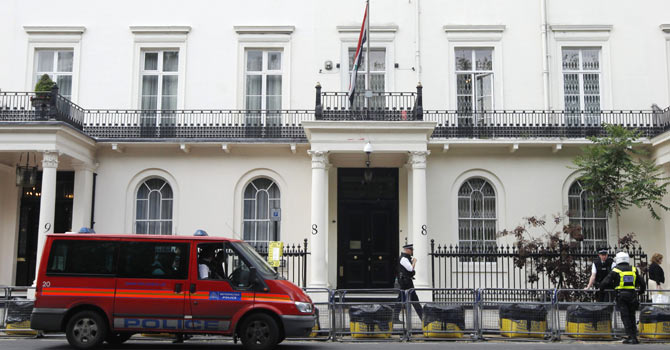
Britain is expelling three Syrian diplomats to protest the Houla killings, among them Charge d'Affaires Ghassan Dalla, the country's top ranking diplomat in London.
In Canada, Foreign Minister John Baird said all Syrian diplomats and their families have five days to leave. Another Syrian diplomat expected in Canada will be refused entry.
In France, Syria's former colonial ruler, new President Francois Hollande showed that he is not backing down from his predecessor Nicolas Sarkozy's tough line on Syria.
Ambassador Lamia Shakkour was notified Tuesday that she is persona non grata, along with two other embassy officials, the French Foreign Ministry said. Hollande said Shakkour is being expelled but that the timing is complicated by her dual status as Syria's ambassador to Paris-based UNESCO.
Hollande said that after high-level discussions with British Prime Minister David Cameron and UN Secretary General Ban Ki-moon, it had been decided to deploy ''a certain number of ... pressure tactics,'' against Syria, including the expulsion of the ambassador.
Germany on Tuesday announced Syria's ambassador, Radwan Loutfi, had 72 hours to leave. Foreign Minister Guido Westerwelle said Germany and its allies hope ''that this unambiguous message does not fall on deaf ears in Damascus.''
''The Syrian regime bears responsibility for the terrible events in Houla,'' Westerwelle said in a statement. Westerwelle said Germany will push for the UN Security Council to consider the situation in Syria again.
''It has been clear not just since Houla that Syria has no future under Assad,'' Westerwelle said. ''He must clear the way for peaceful change in Syria.''
The Italian Foreign Ministry said Ambassador Khaddour Hassan was summoned and informed that he must leave. Spain said it was giving Syrian Ambassador Hussam Edin Aala and four other diplomats based in Madrid three days to leave the country.
Baird said these ''Syrian representatives are not welcome in our countries while their masters in Damascus continue to perpetrate their heinous and murderous acts.''