PAKISTAN has failed to educate its children. This is shameful and now we have the proverbial insult added to injury.
It is in the form of the numerous myths and misconceptions about language circulating on the Internet and in conferences on education that have caught the public imagination. This creates pressure for education in English.
An article by Gwynne Dyer, a Canadian syndicated columnist, in this paper spoke of ‘The triumph of English’. It was a clever piece of writing in that it dwelt very convincingly on the importance of the English language in the globalised world of today. It also said, “The amount of effort that is being invested in learning English is so great that it virtually guarantees that this reality will persist for generations to come.”
Dyer refrains from highlighting the negative aspects of this triumph of English which a blogger suggested should have been headlined ‘the triumph of colonialism’. The fact is that an indiscriminate and wholesale adoption of English or its pseudo version as the language of education is undermining our education system. The focus is so much on English that knowledge, information and critical thinking are being sidelined by the effort to teach English.
I am all in favour of our children learning English in school, albeit as a second language. I also wish that more effective methodologies were adopted so that the child actually learns the language. That, however, does not mean that the medium of instruction should be English. Teaching English is different from teaching in English.
Quick to jump on the English bandwagon are a number of people who have little understanding of education and even less of language acquisition. They also fail to look at the ground realities in Pakistan. There is no attempt at any self-analysis. This is what one of them wrote, “Anyone who is opposing the English language and its value in Pakistan must read this eye-opener (Gwynne Dyer’s article). Our ideologues will still not want to buy it but that is precisely why in Pakistan we have pressed the reverse gear of history on all counts.”
I am not very clear who he is referring to when he speaks of ideologues. I know this much that those championing the use of English as the language of education are the ones pressing “the reverse gear of history”.
To help readers recall what Thomas Babington Macaulay, a member of the governing council of the East India Company, had to say about education, I cite from his famous Minutes on Education (1835), “…it is impossible for us, with our limited means, to attempt to educate the body of the people. We must at present do our best to form a class who may be interpreters between us and the millions whom we govern; a class of people Indian in blood and colour, but English in taste, in opinions, in morals and in intellect”.
Nearly 176 years after these words were written, it seems our makers and shakers have reverted to what our colonial rulers were saying. The articulation is different. A bureaucrat-educationist told me that the language myths are now promoted by the power wielders who don’t want the masses to be educated. Gone are the days when a wadera could stand up and refuse to allow a school to be opened in the area under his control. Now he allows a school to be set up but ensures that the children learn nothing.
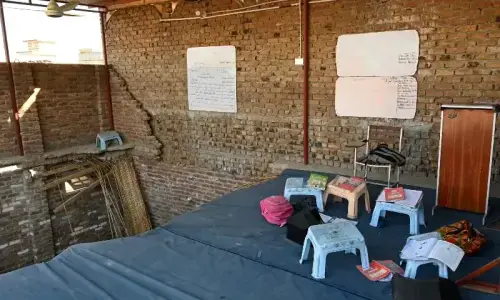
What about the children themselves? I conducted a small survey in which about 85 children from four schools participated. All the children came from the low-income classes (their family income was said to be about Rs10,000-15,000 per month). Apart from one school which claimed a literacy of 50 per cent among parents thanks to its community programme, the others said barely two per cent of the parents are literate. Run by various organisations which raise funds and are trying to improve the lives of the deprived children, the efforts of the schools are to be commended. While two are using English as the medium — the Pakistani way — the other two have opted for Urdu.
Some initial observations are instructive. The grade 5 children tested were of ages ranging from 11 to 13 years. They were given a simple paper of grade 4 level with questions in English on one side and Urdu on the other.
They were offered a choice of language in which they wanted to write. While all 10 of the children from an ‘English-medium’ school opted for Urdu, two out of 17 from the better ‘English-medium’ school did the entire paper in Urdu. Six were bilingual — doing one question in English and the other in Urdu. Nine wrote their answers entirely in English. This indicates the comfort level of the children in language. Forty-one of the 85 children tested did not speak Urdu at home. Yet all of them found it easier to communicate in Urdu than in English since Urdu is the language of the environment in Karachi.
Broadly speaking, the children from the Urdu-medium schools could articulate their ideas better and showed better critical thinking. Of course we still have to go a long way to reach satisfactory standards in Urdu too.
A beginning has to be made but first we must sort out the issue of which language should be the language of education. The children’s concerns must be kept in view.