



 0
0

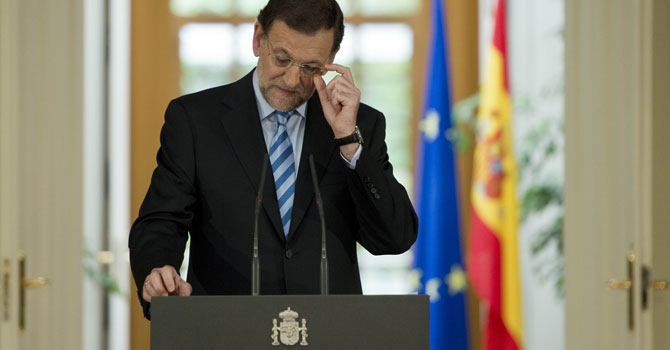
MADRID: Spain's leader hailed Sunday a eurozone lifeline of up to 100 billion euros ($125 billion) to save its stricken banks as a victory for his country and for Europe.
Despite flatly denying any need for a rescue just 13 days earlier, Prime Minister Mariano Rajoy insisted Madrid had not caved in - instead he had been pressuring for the aid.
After an emergency video conference on Saturday, the 17 eurozone finance ministers said in a statement they they were “willing to respond favourably” to a Spanish plea for help.
“I am very satisfied, I think we have taken a very decisive step,” Rajoy, who had been criticised in the media for failing to appear earlier, told a news conference.
“Yesterday, the credibility of the euro won, its future, and the European Union,” the prime minister argued.
“It was not easy,” he conceded.
“Nobody pressured me and I don't know if I should say this, but it was I who pressured for a line of credit,” said Rajoy.
The rescue loan for Spain - hailed by Germany, France, Japan and the United States as well as the IMF - marked a dramatic, public U-turn for Spain, which had hotly denied any need for outside aid.
The eurozone debt crisis has now snared the bloc's fourth-biggest economy - Spain's is twice the combined size of those of Greece, Ireland and Portugal, the countries bailed out so far.
Spain finally sought aid as its borrowing costs on the open markets soared and the price for fixing the banks' balance sheets, heavily exposed to a property bubble that burst in 2008, spiralled.
Recently nationalised Bankia, which has the largest exposure to real estate, needs an extra 19 billion euros to repair its books in addition to 4.5 billion euros already injected by the state.
Economy Minister Luis de Guindos told a news conference on Saturday that the loan of up to 100 billion euros did not amount to a rescue and Rajoy declined to be dragged into that debate Sunday.
De Guindos said the loan would be provided on preferential terms and a source close to the talks told leading daily El Pais it would cost three percent a year, far less than the rates of around six percent Spain is paying on the open market.
The government highlighted the fact that the deal imposed no new austerity measures or restrictions on the broader economy.
Nevertheless, eurozone ministers said they were confident Spain would honour commitments to cut the deficit and restructure the economy. “Progress in these areas will be closely and regularly reviewed,” they said in the statement.
Most of the Spanish newspapers' front pages headlined with the word “Rescue,” although some sought so soften the blow. “Rescue without humiliation,” insisted the conservative daily El Mundo.
“So we have a new concept. A 'lite' bailout with no material conditions on the sovereign and instead merely the banks that apply,” Lloyds Banking Group economist Charles Diebel said in a report.
“This is the latest in the long list of euro measures to stem the crisis.
“Will it be enough? That's questionable as it is still prevention rather than cure and again only keeps the banking sector alive rather than really supporting growth.”
The scale of the aid depends on an external audit being carried out for Madrid by consultants Roland Berger and Oliver Wyman. The audit is due by June 21 but de Guindos said it would ready within a few days.
International Monetary Fund bank stress tests, unveiled Friday three days ahead of schedule, determined that Spanish banks need about 40 billion euros in new capital, with a backstop on top of that.
Spain's economy minister stressed that the aid would include a big safety margin while the assistance is to be channelled through Spain's state-backed bank restructuring fund.
The eurozone hopes the rescue will satisfy financial markets and put Spain in a safe harbour ahead of the Greek elections on June 17, when there is a risk voters could reject their bailout terms, forcing Athens into a destabilising exit from the eurozone.






























