WASHINGTON: The United States has withdrawn negotiators from Pakistan after talks failed to produce an agreement on reopening vital Nato supply routes into Afghanistan, the Pentagon said Monday. “The decision was reached to bring the team home for a short period of time,” Pentagon spokesman George Little told reporters.
The team of negotiators had been in Pakistan for about six weeks, he said, as US officials had believed they were close to a deal with Islamabad to lift the blockade on Nato convoys.
But no breakthrough was imminent and there was no scheduled date for a resumption of the negotiations, Little said.
The United States, however, would continue to maintain a “dialogue” with Pakistan and the departure of the expert negotiating team did not mean Washington had given up discussions with Islamabad, he said.
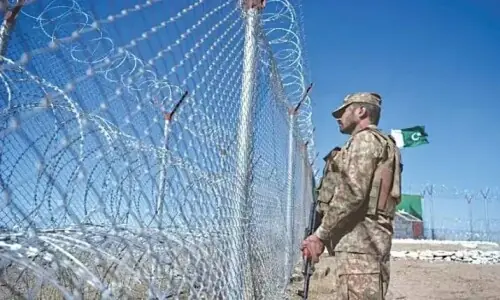
“That’s not to be taken as a sign of our unwillingness to continue the dialogue with Pakistanis on this issue,” he said, adding that the negotiators are “prepared to return at any moment.” Pakistan shut its border to Nato supply convoys in November after a botched US air strike killed 24 Pakistani soldiers.
Members of the negotiating team started to leave over the weekend and the remainder of the negotiators would soon return to the United States, Little said.
The comments came after Pakistan’s army chief, General Ashfaq Kayani, refused last week to meet US assistant defense secretary Peter Lavoy, who traveled to Pakistan to try to resolve the dispute, officials said.
Lavoy “was hoping to meet with General Kayani to work through this issue,” Little said.
The roads through Pakistan are a crucial logistical link for Nato as it plans a large-scale withdrawal of combat troops and equipment by the end of 2014.
But US officials have so far rejected Pakistani proposals to charge steep fees of several thousand dollars for each alliance truck crossing the border.
Washington has also refused to issue an explicit apology for the lethal air raid.
With the Pakistani roads shut, the US-led Nato force has relied on cargo flights and northern supply routes – negotiated with Russia and a network of governments in Central Asia and the Caucasus.
But the northern routes are much longer and more expensive than the Pakistan roads.
“The more options you have available to you when you’re mounting a major logistics effort, like supplying the war effort in Afghanistan, the better,” Little said.
“As a technical matter, we could in theory do our work without the ground supply routes. It would certainly be better to have them open and less costly.”
The stalled negotiations also coincide with remarks last Thursday by US Defense Secretary Leon Panetta, in which he accused Islamabad of failing to crack down on Haqqani insurgents operating inside Pakistan and attacking US-led troops in neighboring Afghanistan.