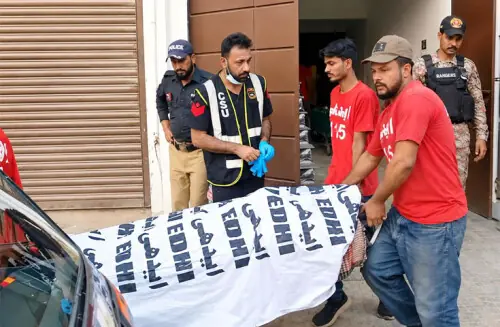
KARACHI, June 14: A 57-year-old farm worker from the Dalbandin area in Balochistan — admitted to the Liaquat National Hospital in the city with a history of high-grade fever, muscle pain and gum bleed — died on Wednesday, it emerged on Thursday.
Sources at the LNH said that the Pashto-speaking patient was admitted to the hospital on June 10. He tested positive for Crimean-Congo haemorrhagic fever (CCHF) virus infection at a private university hospital laboratory. He became tachypnic, his oxygen level dropped after midnight and he was declared clinically dead on Wednesday morning.
Ahmedullah, a trader from Quetta accompanying the patient, told Dawn that the dead was a relative of a customer of his and he was a member of the team that came to Karachi. “As I was told, the man kept a cattle herd at his home in a village some 600 kilometres from Quetta and received treatment at a private hospital in Quetta before coming to Karachi,” he said.
The dead was a resident of Gardi Jungle district, near Dalbandin, and was doing different jobs, including feeding goats and cleaning cattle pens, to earn a living.
Having symptoms such as low-grade fever, myalgias and generalised weakness, he continued working before he began bleeding from the nose which became profuse in the next half an hour.
The patient was admitted to the LNH in the evening on June 10 and shifted to the medical ICU.
Three deaths caused by the CCHF virus infection were reported in 2010, two in 2011, including that of a doctor who was believed to have contracted the deadly viral infection during a surgical operation in Quetta, and a young man of Gazdarabad, Ranchhore Line.
A source at the Dengue Surveillance Cell of the Sindh Health Department, which also records CCHF cases reported in the province, said four persons had been reported as confirmed CCHF patients by three different private health concerns in the city this year. Three of them, including the latest victim, came from Balochistan, said the source, adding that the death of the patient was the first caused by the CCHF in the city this year.
Dr Shobha Luxmi, an infectious disease consultant at the LNH, said the patient had the history of handling livestock as well. The CCHF was a tick-transmitted viral haemorrhagic fever and its sporadic cases and outbreaks affecting humans did occur in Pakistan, she said, adding that the disease was endemic in many countries.