0
0

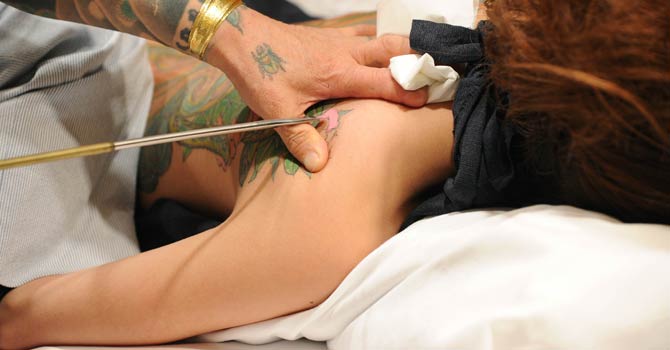
TOKYO: For tattoo artist Horiyoshi III, the skin into which he sinks his ink-infused needle is a canvas for the myths and legends of Japan -- where body art is indelibly linked to the criminal underworld.
The mountains and waves of 18th century art, or fabulous mythical creatures are a far cry from the stylized designs so common in the West that might usually draw disapproval from parents and teachers.
But the tattoo in Japan has a much worse reputation, associated with the violent gangsters of the yakuza criminal underworld—an association that ink proponents argue is unfair.
Horiyoshi—who uses the modern metal variation of a bamboo stick still favoured by some traditionalists—says his biggest inspiration is Hokusai, an artist famed for woodblock prints of a tsunami against Mount Fuji.
“But I am also influenced by other Japanese artists,” he said at an exhibition of his work—with all live subjects—last month in Tokyo.
“And of course I do not exactly reproduce their works: I have to adapt their designs to the bodies on which I work.” Former gym teacher Asada Yoshi is covered with the master's designs, which re-tell Japanese mythology on the 52-year-old's body.
“On the right leg, you see a koi (Japanese carp) jumping and on the left leg a creature—half dragon and half koi—and then on the back I designed a massive dragon,” said Horiyoshi.
“It refers to an ancient legend in which the carp turns into a dragon after it swam against a waterfall.”
He says, unlike those popular in the West, tattoos in Japan have their own narrative and do not borrow from other cultures.
“The biggest difference is that tattoos in the West are created to underline a person's individuality,” he says.
“They want to make a statement or remember something they are a really big fan of. But in Japan some groups get tattoos not to underline their individuality because individuality is not so important in Japan, it's the group that is important,” Reinke added.
“Usually, a group that is tattooed by the same master kind of forms a little club by themselves, like here today where everybody who is meeting has been tattooed by Mr Horiyoshi and is just having a good time.”Yoshi concedes, however, that having a tattoo in his old job as a gym coach was “impossible.”
It’s hard to get a tattoo in Japan,” he says.
Tattooed people are barred entry from scores of venues in Japan, from hot springs to fitness centres, while the mayor of Osaka recently forced city employees to fill out a survey revealing whether or not they have a tattoo.
That discrimination is tied to a seemingly unbreakable association with the yakuza, whose members' distinctive tattoos denote their association to crime families, such as the Yamaguchi-gumi.
“Tattoos have a bad image everywhere, but particularly in Japan they are associated with violence and yakuza, even if that is a simplistic view,”Horiyoshi says.
“This image is still stuck in peoples' minds: tattoo equals criminal, criminal equals yakuza. People are now scared of tattoos.”