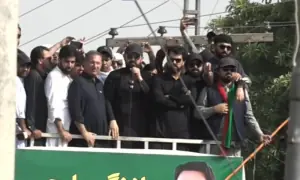
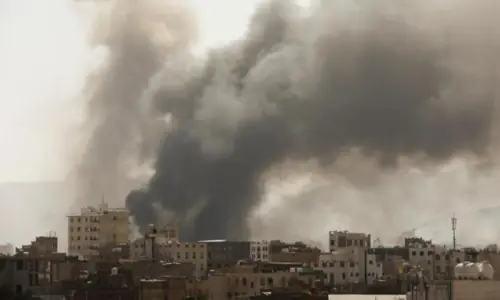
LAHORE: An unprecedented power shortage touching almost 70 per cent of the demand and the resulting outages and loadshedding triggered violent protests across Punjab on Sunday with angry people setting on fire public property, including police stations, and blocking roads and railway lines.
A number of cities witnessed violent protests when power outages stretching up to 22 hours forced people to take to the street. In some cities, including Lahore, demonstrations were led by PML-N leaders and supporters.
In Chichawatni, protesters set ablaze two police stations, Mepco’s offices, vehicles and motorcycles and attacked the residence and election office of a PPP MNA.
Reports said that an unruly mob was almost in control of Chichawatni for eight hours with police remaining silent spectators.
In Khanewal, protesters ransacked Mepco offices, residences and factories owned by politicians, damaged vehicles and clashed with police.
There were massive protests in Gujranwala where enraged people blocked the Railway Line, GT Road, set ablaze tyres and smashed windows of a bus and an ambulance. The protesters also did not allow a PML-N MNA to take part in their rally.
In Toba Tek Singh, protesters blocked the rail track for about two hours. In Kamalia, people pelted private vehicles with stones and blocked the Kamalia-Chichawatni Road for two hours.
In Faisalabad, dozens of people pelted police with stones on Samundri Road during a demonstration against power outages. Police used teargas to disperse them.
The protesters, most of them power loom workers, converged on the Samundri Road and blocked the thoroughfare for more than two hours by placing burning tyres on the road.
According to the power planners, the generation dropped to a paltry 9,400MW against the total demand of 17,400MW. But of the 9,400MW, 600MW was diverted to the Karachi Electricity Supply Company (KESC).
Another 600MW went to transmission losses, bringing supplies for the common man down to only 8,200MW. Of that, around 2,200MW was supplied to 184 feeders which were exempted from loadshedding and to the industry where loadshedding was limited to only six hours. It left only 6,000MW for general supplies against a demand of 17,400MW.
Power plants which are out of operation because of the fuel supply crisis include Orient Power (213MW), Halmore (207MW), Saif (210MW), AES Lal Pir and Pak-Gen (700MW) and Saphire (209MW). Hubco is producing 300MW less than its capacity and Kapco only 876MW against its capacity of 1,350MW. It is a simple fuel crisis.
“No-one really knows who is running the power show in the country,” said an official of the Ministry of Water and Power.
“The cabinet decides that power sector should be getting 207 million cubic feet gas (mmcfd) a day. Both the SNGPL and the SSGPL refuse to provide gas, claiming that they don’t have it. How would one know whether the prime minister is in-charge or MDs of these two companies? The federal minister (Chaudhry Ahmad Mukhtar) is new and still trying to find his feet. The Pepco is officially dissolved but is still working with an MD in the chair. If there is no-one in-charge, where should the proverbial buck stop? And, even dangerously, who should regulate generation and distribution. The sector has become a rudderless ship, with things worsening by the day,” the official said.
“The sector collects around Rs1 billion a day in bills, whereas it needs Rs3 billion for fuel,” a Pepco official said.
“If distribution companies improve their recoveries, they can double that amount. Since they are not doing it, it is a daily loss of Rs2 billion only on account of fuel. Who can run the sector without this money? All official claims and shuffling of people around is a survival effort by the government. Otherwise, everyone in the sector knows the problem and its depth; it is an existential threat, spinning out of hand by the day,” he warned.