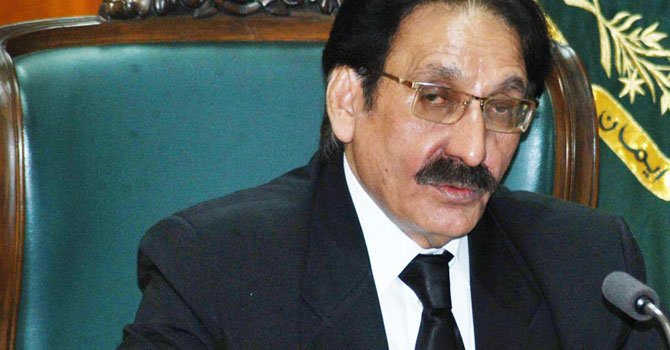
ISLAMABAD: Parliament cannot adopt a law that is repugnant either to the Constitution, Islamic injunctions or fundamental rights and if it does so, the action will be open to judicial review, Chief Justice Iftikhar Muhammad Chaudhry said on Saturday.
The chief justice told a 50-member delegation of a mock Youth Parliament that an underlying objective of judicial review was to check abuse of power by public functionaries and to ensure fair treatment to all citizens in accordance with law and constitutional norms.
He said the Supreme Court, through its judgments, had stressed the need for adherence to law and the Constitution in order to bring about civilised governance in the country.
“Law applies to all, irrespective of their status, power, caste, creed and religion. No one can claim supremacy over and above the law,” Justice Chaudhry observed.
Talking about trichotomy of powers, the chief justice said: “The Constitution is a complete document which answers all questions. Every organ of the state enjoys complete institutional independence within its constitutional domain. However, any excess or misuse of power beyond that domain becomes the subject matter of judicial scrutiny.”
The judicial institution of the state with the Supreme Court as the final arbiter acts as the ultimate protector of citizens’ rights and upholder of constitutional supremacy. The Supreme Court enjoys original, appellate and advisory jurisdiction, he said.
The advisory jurisdiction of the Supreme Court extends to matters referred to it by the President for obtaining its opinion on any question of law which he considers of public importance, the Chief Justice added.
In 2005, the Supreme Court while deciding a presidential reference made under Article 186 of the Constitution declared certain provisions of the North-West Frontier Province Hasba Bill as null and void, he recalled.
Likewise, he added, the Supreme Court, to the exclusion of any other court, had the jurisdiction to pronounce declaratory judgments in any dispute between the federal government and a provincial government or between any two or more provincial governments under Article 184(1).
Justice Iftikhar Chaudhry said where any question of public importance arose with reference to the enforcement of any of fundamental right, the Supreme Court has the power to issue an order for enforcement of these rights.
The chief justice said: “Youth being a crucial segment of society forms the basis for future development, and you are also face and future of nation. I am hopeful that ambitious and zealous young people of today will prove to be the true leaders of democracy in future.”
Giving a piece of advice to members of the delegation, he said: “As you are young and have to set a future roadmap for democratic rule and harmony in Pakistan, I would like to advise all of you to study the basic features of our Constitution and also how the document has been interpreted by courts so as to acquaint yourselves with constitutional history and the role of superior courts in protecting fundamental rights and the constitutional development of Pakistan”.
Senator S.M. Zafar and Wazir Ahmed Jogezai, a former deputy speaker of the National Assembly, accompanied the delegation.