0
0

KETI BUNDAR (Thatta), June 25: Keti Bundar, a small dusty town on Thatta’s coastal strip, faces serious existential threat from sea intrusion and a persistent shortage of drinking water.
Scarcity of drinking water is the major cause behind migration of a large number of fishing community. “The poor don’t get access to a filter plant to fetch water,” says a local, Wali Mohammad Mir Jatt in the town’s main bazaar.
Fishing is the main source of livelihood but it is on the decline for multiple reasons, like marine and industrial pollution, harmful fishing methods like use of illegal nets, destruction of deltaic ecology and shrinking cover of mangroves.
Pakistan Fisherfolk Forum’s Gulab Shah said Keti Bundar had schools but no teachers and hospitals but without doctors.
Khariyon, a village near Hajamro creek, is fast disappearing. The delta has 17 such creeks which used to be fed by the Indus. But now seawater has intruded into them.
“You can notice dislocation of the village by watching earth maps on the Internet,” said Shakeel Memon of a community-based volunteer organisation of Keti Bundar as he guided a group of journalist on a boat to the village.
Keti Bundar is part of Indus delta, said to be the seventh largest in the world, and the delta is dying because of non-release of adequate quantity of freshwater of the river into the sea.
According to chairman of PFF Mohammad Ali Shah, 600,000 people have migrated from the area since the Tarbela Dam was built on the Indus. Total population in Sindh’s delta region was about two million, he said.
“Obstructions and cuts on the river are the main causes of destruction of the delta. We need a new water paradigm and, therefore, we have launched ‘keep river free’ campaign to handle the crisis,” he said.
He said similar campaigns had been launched in a number of countries of the world for de-commissioning of water storage dams.
About 1.2 million acres of Thatta and Badin districts and 350,000 acres in the command area of Kotri barrage have been swallowed up by sea. Sea intrusion picks up pace in the absence of mangroves because the plants serve as a bulwark against cyclones and also a breeding ground for fish and shrimps.
Sindh strongly believes that 10MAF of water is needed downstream Kotri barrage, which is not released because of shortage in the Indus river system.
“Two studies had been carried out by the ministry of water and power in 2005, which concluded that 25MAF water was needed downstream Kotri in five years or 5MAF every year to save the delta. And about 5,000 cusecs (3.6 MAF) needs to be released daily throughout a year,” said irrigation expert Idris Rajput. “But it is not done,” he adds.
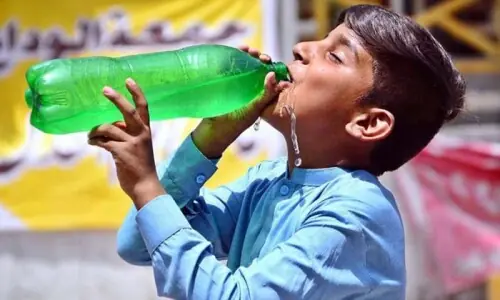
People face food scarcity and drinking water has become a precious commodity in areas like Kharochaan, Shah Bundar and Keti Bundar.
General Secretary of Friends of Indus Forum Nasir Panwhar calls for setting up an independent body to oversee Indus delta rehabilitation programme, which should envisage revival of lost species, protection of environment, resettlement of people and long term coastal zone management.
According to WWF’s Tahir Abbasi, site coordinator for WWF’s climate change action project (CCAP), the community was engaged in mangroves plantation in Hajamro creek.
WWF is working on different areas under CCAP so that community could be equipped with techniques for climate change related adaptation.