12
12

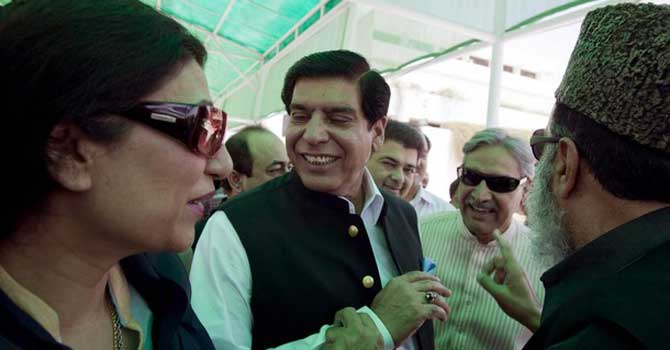
ISLAMABAD: These days, politicos, journalists and anyone with even an eye or a teensy thread linking them to the political sphere in Islamabad has the same question at the tip of their tongues: so exactly how long will the brand new prime minister of the Pakistan People’s Party last in the face of the Supreme Court judgment on the National Reconciliation Ordinance (NRO)?
When the same question was posed to Senator Aitzaz Ahsan — who just so happened to represent former PM Yousuf Raza Gilani in the contempt of court case — he had replied in a very matter-of-fact manner, “The ruling PPP would have to sacrifice three prime ministers before it reaches the next general elections.”
Given that the current National Assembly has nine months left to complete its five-year constitutional term in March, 2013, by Senator Ahsan’s measure, Prime Minister Raja Pervez Ashraf has at the very maximum three months at the helm of affairs — and then his replacement walks in.
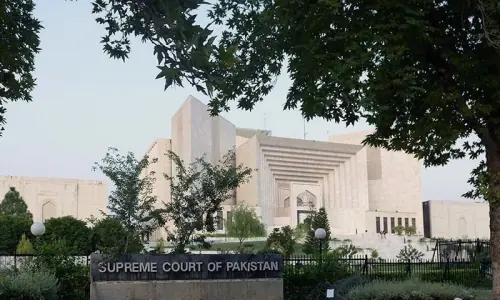
However, an equally important question that is not being asked as often is, would the Supreme Court after packing off one elected prime minister, continue with its hostile posturing towards the PPP-run executive?
Many believe it wouldn’t be easy for the apex court to immediately send away Mr Ashraf, and the judges would have to look harder for another reason to get its NRO judgment implemented.
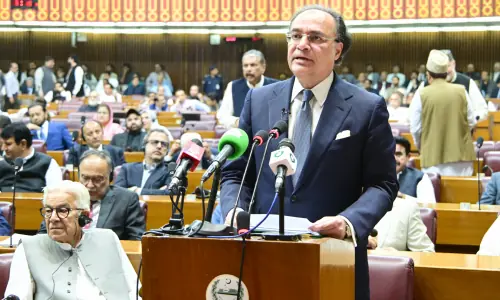
The judiciary would also have to deal with the new situation that is emerging with the government planning to introduce changes in the law of contempt whereby top public office-holders both at federal and provincial level would be given constitutional protection against contempt charges.
The bottom line for many hawks is that the judiciary would have to wait some time before it goes after Prime Minister Ashraf. And of course, that means PM Ashraf would get a few more weeks if not months to his already brief tenure as the premier of the country.
So far, rumour has it that the government plans to get the proposed changes in the law of contempt passed by the Parliament House before July 12, when PM Ashraf has been asked to submit his response to the court on the issue of sending a letter to the Swiss authorities against President Asif Ali Zardari.
The National Assembly will meet on Friday July 6 followed by the session of the Senate on July 9. It has to be pointed out that these are not regular sessions of the two houses of the parliament.
The government has also announced that it will bring in another controversial draft bill for amendment in Article 63 (1) C of the Constitution to remove constitutional bar that stops Pakistanis carrying dual nationality from contesting elections.
“If the parliament has the right to legislate, then under the Constitution the Supreme Court has the right to interpret it,” said Yasin Azad, who is currently heading the Supreme Court Bar Association (SCBA).
“In my personal observation, as soon as the government will introduce changes in the law of contempt, they will be challenged in the apex court. Yes, the stand-off will linger on and that might give some more time to the new PM,” Mr Azad responded to a question.
But there are many who do not buy this line of argument. Barrister Zafarullah Khan, a constitutional lawyer, believes that the Supreme Court wouldn’t take much time in striking down any changes in the law of contempt that the government manages to get ratified by the parliament.
“It will be a black-and-white case of mala-fide intent, especially since the Supreme Court has already given its ruling in a contempt of court case committed by the former Prime Minister Yousuf Raza Gilani,” said Barrister Mr Khan
Meanwhile, in a conversation with this scribe, Dr Rashid Ahmad Khan, Dean Faculty of Arts and Social Sciences & Law, University of Sargodha, described the on-going events as a head-on collision between the executive and the judiciary.
Calling for an amicable solution to the constitutional crisis which the country is up against at the moment, Dr Khan warned that if the current situation persisted democracy would suffer.
He opined that many so-called “experts” in the country mixed up presidential and parliamentary forms of governments.
Dr Khan pointed out that in the presidential form of governance, there is water-tight segregation between the legislature, executive, and judiciary whereas in the parliamentary form supremacy of the parliament has to be ensured.
“Whether somebody agrees or not, it’s the parliament from which other organs of the state draw their powers, not vice versa,” Dr Khan insisted.
However, those who are privy to behind-the-scenes maneuverings opine that given the Family-gate fiasco at whose center is the son of the chief justice, the judiciary and in particular Chief Justice Iftikhar Muhammad Chaudhry has had their moral high ground compromised. “The plan is to provide safe passage to all political players of the country,” one of them revealed.
But whatever the plan may be, it is clear that the end result is to prepare for the general elections later this year and ensure a smooth transition to the next government.