5
5

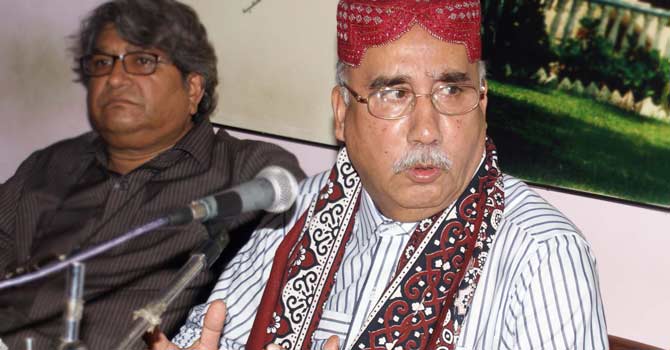
“Classical music forms the base of our musical heritage,” opines Wajahat Attray, a leading composer in the Pakistani film industry. “Younger generations must learn classical form in order to help revive the flailing industry,” he adds.
Attray is visibly upset at the continuous decline of the film industry, as well as music. “Quality music, backed by deep lyrics can help stall the decline,” he says. His displeasure with pop music is quite evident, based on his extensive experience in the industry. Attray, son of music icon Rasheed Attray, has composed music for some 450 odd films.
“Those who understand music will not prefer this “rang bazi” (vulgarity in music) as it is only short lived.” Staying in touch with the times, Attray admits that pop singers and their music are able to evoke an electrifying response from the audience but they don’t last long in their minds. “People don’t remember such songs for too long. Even when a song becomes a hit, it is usually not followed by another one,” he adds, referring to numbers such as “Channo” and compares it with the classics such as “Mujh sey pehli si mohabbat” or his composition “Main jeena tere naal” from the film “Mohabbatan sachiyan.”
“Pop singers are paid well for a certain hit song but then they disappear as they don’t have equally popular numbers in their repository,” Attray says.
“Do you believe that people like recent hits like “Munni badnaam” or “Sheela ki jawani.” No.” Attray reminisces about the time when Pakistani music dominated the silver screen, not just in the big cities, but all parts of the country. He is not completely averse to the modern ways. “I modernised my composition “Luddi hey jamalo” although I had fewer resources but I still tried not to lose the classical aspect,” Attray tells Dawn.com.
Elaborating on state of the silver-screen scenario, he highlights the wide gap in Pakistani film industry between the periods of its glory and the state it is in now. “Quality work is missing in films even in an ever-growing industry such as that of India. Vulgarity in music has widened this gap,” he says.
Memorable music, he believes, is achieved with the combination of a good poet and seasoned music director. “Then there is the point of ‘riazat’ (practice) which singers are not ready to do. They can’t do it as they avoid it.”
“For whom I should compose a song when most singers can’t sing such compositions. Unless singers learn it we will have to be bear with the music being produced currently,” he adds. He counts singers like Rahat Fateh Ali, Humera Channa, Hamid Ali Khan and Shafqat Amanat among current lot of singers who can sing his composition based on classic music. “They have the guts”, he says, pointing out that Sajjad Ali as a vocalist of different kind. “Rahat Fateh Ali is full of potential too and he has proved himself in India, where he is dominating the film industry,” says Attray, conceding that even members of singers’ families from Patyala and Gawalyar are contributing to pop singing.
The music-industry is veteran is happy to pass on his experience but says that despite the massive expansion of media, people of his likes are not invited to speak on issues confronting decline in classical music. “I can educate youngsters in any academy and this form of music has to be resurrected. But then the government’s attention is missing. When government doesn’t pay attention to us how can it be expected to be attentive to younger lot interested in learning music,” he complains. Youngsters need to understand ‘rag’ and ‘ragni’. Media houses are interested in news of terrorism, murders, crimes, ouster of government and such stories. “Services of s composers and lyricists can be encouraged and used to set-up an academy”, he says.
Despite a recent increase in film viewing figures due to a boom in multiplexes and theatres, Attray remains unconvinced.
“There is a big difference in sound quality used in these cinemas and our conventional film making. Our sound effects are based on mono technique whereas these cinemas have impact sound.”
For him idea of fusion – a blend of eastern and western music – is good but not ever-lasting. “Take my word, classical music will return. I have proved it in Mohbattan Sachiyan’s “Main Jeena Teray Naal”, he says. “We should be serious enough to keep our film industry alive. Our film industry can only be revived with quality cinema houses,” says Attray and adds that producers are trying to come up with quality films and people who are demolishing cinema houses for their business should not do that.
Syed Noor – one of top film makers the country ever produced – also supports Attray’s views. “A change in the film industry is needed,” he says. “When you start taking interest in watching song more than listening to it, this creates difference and secondly our youth is inspired from western music, which is better for than music or quality. We used to record songs …people would listen them on radio and then came cassettes so there was a charm in listening music. It all has changed now” says Noor, who brought life back to cinema houses with his productions like “Jeeva”, “Ghunghat”, “Sargam” and “Hawaien” in the mid 1990s. After that, the film industry relapsed into crisis.
“We can’t compare western music with that of legends such as Ahmed Rushdi and Mehdi Hassan,” he adds. Noor believes the decline in Pakistan's film industry came into effect after the new millennium. “Until 2000, the film industry was doing well. At the turn of the millennium, it hit rock bottom,” he says. “We failed to keep up with emerging technological trends in the field.”
Then, Noor says, the local audience compares the filmmaking with those produced in India. “We were hit by an issue which is lack of depth in the subject of film as we are still glued to stereotypes so our films on the whole remain weak.”
The days are over when films like “Aik Hamraz”, “Naila”, “Amber”, “Bandish” were produced. Cinema houses are old and some have failed to upgrade with changing times. Noor says filmmakers face a dilemma. “They wonder if they should keep coming up with subjects like that featured Sultan Rahi type roles or cater to the taste of the youth?”
“Financing remains a major concern. Can our Rs10.5-million film compete with a Rs1000-million budget film?” he emphasises the need for changing paradigm in film industry to have quality productions. “We have to produces films to simultaneously meet demands of 40 or 50 plus age groups and youth, otherwise, we will be heading to a blind ally” he adds.
Die-hard film-goer Yasin Hameed – who has seen close to 1,000 odd films so far – doesn’t watch films any more. “Our films have no content, which was there in the films of Mohammad Ali and Nadeem,” says Hameed, who started watching movies at the age of five.
For him decline in films has multiple reasons. “Decades of 1980s and 1990s formed the peak period of our films. After the 1960s, films used to have golden and diamond jubilees,” he adds. “Then, Ziaul Haq proved disastrous for our film industry. He even ordered to censor scenes where hero and heroin would embrace each other. Use of certain words was banned,” he adds.
Yasin points out that different communities objected to film production if it centered on them. For instance films “Kalu Makrani” and “Begum Jan” or “Qasai Puttar” fall prey to this issue. In “Begum Jan” a girl played the role of cloth selling woman of a particular community background and that community reacted to it,” he says.
When film director, actor-cum-comedian and now TV host Omar Sharif came up with “Mr.420” it brought audience back to cinema houses and then “Jeeva”, “Ghoonghat” and “Hawaien” came as a hope for revival of film industry. “From year 2000, onwards film industry is at the verge of total destruction a as we start having films on topics based on vulgarity and nudity”, he says.
“Nudity is not film.”
Yasin feels that after some popular hits even Syed Noor came up with productions lacking substance. “After all he has to meet his financial needs so I feel he is also compromising on quality…we used to have a production brand that guaranteed success but not anymore.”
“It was painful for me to see Syed Noor coming up with a film that seems to be third-rated. When films that have his name attached to it offer no substance, why will people like me go to the cinema?”
Hameed says that he feels “Ishq Khuda” which is due to release on this Eidul Fitr may mark the beginning of a new era for our film industry as it is being produced by Shahzad Rafiq, who has films like “Mohbattan Sachiyan” and “Salakhien” to his credit. Attray's music composition will also feature in this film which is centered on Sufism.
The author is a senior correspondent for Dawn based in Hyderabad.