0
0

Estimates about incidence of poverty and inequality have always remained questionable in Pakistan, owing to political reasons and lack of technical competence or independence of institutions responsible for such surveys.
These became controversial in 2004-05 when General Pervez Musharraf-led government made public the findings of poverty related survey, saying the incidence of poverty had dropped significantly from 34 per cent in 2000-01 to 23.9 per cent in 2004-05 and took credit for its economic policies for improving the standard of living of the people.
Subsequent survey in 2007-08 reported further improvement in the living standards which reported incidence of poverty at 17.2 per cent. The then PPP deputy chairman planning commission did not allow publication of the report, saying his own assessment suggested 40 per cent population was living below poverty line.
But more importantly and interestingly, the findings and data relating to the latest survey completed in 2010-11 has since been held up at the Planning Commission for over a year now. An official committee that was assigned to look into the data has found a further reduction in incidence of poverty from 17.2 per cent in 2007-08 to 12.4 per cent in 2010-11.
The findings are such that even the economic managers who should have otherwise taken credit for improvement on social and living standards of the people could not believe it and have decided against its publication.
And the economic managers have reasons to hold back these findings so that the political leadership may like to capitalise on it before coming elections. The economic managers, however, cannot explain improvement in living conditions of large population when economic growth rates have struggled between 1.7 per cent and 3.7 per cent since the PPP-led coalition came into power.
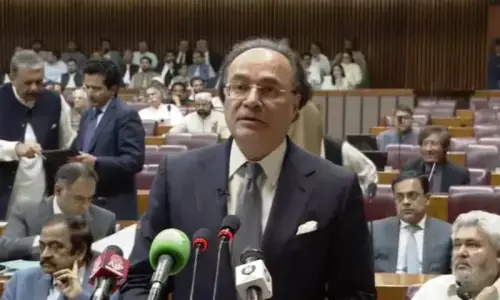
The assessment of the data for the 2010-11 survey also noted that besides poverty, inequality has also declined owing to improved consumption expenditures over the last five years among the lowest quintile of income groups. Based on this finding, Finance Minister Abdul Hafeez Shaikh has argued that low growth also resulted in lower level of inequality among various sections of society.
At a seminar on poverty and inequality organised by the World Bank, he said one should also consider that if the economy was growing and numbers of poor falling, why should there be a cause of concern for the rise in inequality. He said in fact it should be debated if it was better to have less growth and social harmony or higher growth where wealth was accumulated in few hands. Without saying so, he was perhaps critical of his former leader Shaukat Aziz’s argument about trickle down effect of higher growth.
The 2010-11 survey reported incidence of poverty at 7.1 per cent in urban centres and 15.1 per cent in rural areas. Given the fact that PPP’s claim of transferring over Rs400 billion through higher crop prices to the rural areas coupled with cash transfers through Benazir and Punjab Income Support Programmes and rural development, it seems strange that poverty trends have not changed in rural areas.
Interestingly, the sample survey spanning over entire country covered only 16,341 households compared with over 77,000 households in 2004-05 and was based on the same threshold of 2350 calories intake per person per day. It also reported per capita monthly consumption of wheat and rice going up slightly between 2007-8 and 2010-11.
Interestingly, another report of the Planning Commission on change in cost of food basket reported earlier this year that the cost of ‘minimum food basket’ – comprising basic food items – had increased by 79 per cent in four years of the current government, leading to increased hunger, malnutrition and poverty.
“The food basket has shown a consistent increase since 2007 from Rs1000 to Rs1790 (79 per cent) based on retail prices of December 2011”, according to a bi-annual report on Change in Cost of Food Basket (July-December 2011).
In short, the cost of 2,150 calories, needed to keep the body and soul together, increased from Rs960 to Rs1,790, a hike of more than 86 per cent between 2007-08 to 2011-12.
Even more interestingly, the economic survey 2011-12 released two months ago reported that share of food in the monthly per capita expenditure had increased by almost five per cent in four years — from 44.22 per cent in financial year 2007-08 to about 48.91 per cent in 2010-11 — indicating deterioration in the living conditions of a vast majority of middle class population particularly the poor.
The economic survey noted that food price inflation and slow growth over a number of years resulting from the combination of international and domestic shocks had led to a greater share of expenditures going to essential food, fuel and lighting etc. For food items, the major share of consumption expenditure is incurred on wheat, milk, vegetable ghee, vegetables and sugar comprising 58 per cent out of 82.52 per cent expenditure on 17 major food items.
The economic survey also reported that a 10 per cent change in food prices was adding 2.2 per cent or 3.47 million to the poor population.
To top it all, the ministry of human rights reported in February this year an increase in human rights violations to increasing poverty and inequality. In its own words: “The gap between the elite, ultra rich, prosperous business class and the middle and lower middle classes along with the large majority living below the poverty line is so wide that it cannot be filled by ordinary measures. It requires very strong revolutionary steps to address the situation for a better and cordial social environment,” said the ministry of human rights in a testimony to parliament.
“The country is facing a serious economic crunch, where the essential commodities and necessities of everyday life have gone beyond the reach of common man and, at times, are hardly accessible to the middle class.”
Francois Bourguignon, the director of Paris School of Economics who was recently in Pakistan, nicely concluded the debate when he said, growth was a prerequisite for poverty reduction, but growth along with pro-poor policies and equitable growth were essential for vulnerable segments of the society to catch up and not get permanently left behind because of uneven playing field.
He said that redistribution of accumulated resources like education, health services, and access to credit among the poor was the least-cost approach to attaining more equality.