1
1

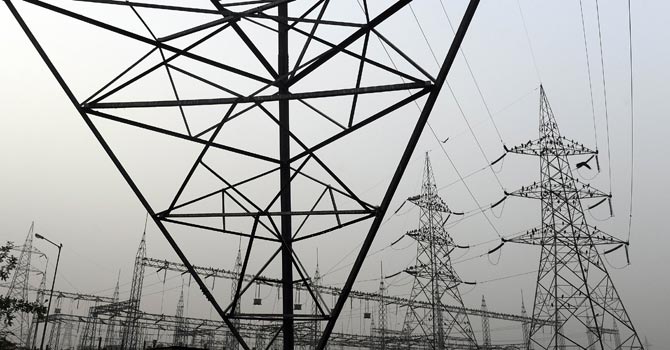
NEW DELHI: India's government faced calls for urgent reform of the power sector Tuesday, after a monster blackout triggered the collapse of the entire northern grid, affecting more than 300 million people.
Leading the high-decibel reform choir were business lobby groups who said Monday's outage — the worst to hit the country in a decade — underlined the government's inability to address India's perennial electricity shortfall.
“The increasing gap between electricity supply and demand has long been a matter of concern,” said Chandrajit Banerjee, director general of the Confederation of Indian Industry.
The CII, Banerjee said, has “consistently highlighted” the need for urgent steps to improve supplies of coal to thermal power plants and reforming state distribution utilities.
“This latest outage is just an urgent reminder for addressing these issues as a priority,” he added.
While the cause of the blackout has yet to be confirmed, Indian newspapers joined numerous experts in pointing the finger of suspicion at energy-hungry states overdrawing their allotted quantity of power.
The northern grid went completely down for six hours on Monday morning, stranding hundreds of trains, triggering transport chaos in cities and leaving a region that houses 28 percent of India's 1.2 billion population without power.
With India running a peak-hour electricity deficit of 12 per cent, power cuts are a daily necessity, and states frequently seek to mitigate the problem by exceeding what is meant to be a carefully controlled power quota.
Although there are financial penalties for overdrawing from the grid, it is still a cheaper option than buying power on the open market for cash-starved state electricity boards.
A member of a three-man team set up by the power ministry to investigate Monday's outage said most states were impervious to official warnings about overdrawing.
“These states have lost all fear. They overdraw from the grid to avoid paying costly power from the market,” the panel member, who declined to be identified, told the Business Standard newspaper.
Vivek Pandit, the director of energy, defence and aerospace at the Federation of Indian Chambers of Commerce and Industry, said such “gross grid indiscipline” could only be remedied with drastic penalties.
“Some states are holding the whole grid to ransom and they should be taken off the grid for a day to stop them feeling they can just act with impunity,” Pandit said.
Alok Brara, publisher of the industry magazine Powerline, said the reluctance of state utilities to purchase power from national energy trading exchanges reflected deep structural problems in both supply and pricing.
“For every 100 units they buy, they will lose 30 to theft. Another 40 will be earmarked for sale to agricultural consumers at highly subsidised prices, leaving just 30 units to sell at a remunerative rate,” Brara said.
“So the argument for them is the more they buy, the more money they lose,” he added.
Apart from an overall increase in power generation investment, analysts and business lobby groups say the most pressing need at state level is to rationalise tariffs and crackdown on widespread power theft.
“Over the years, people have just got used to taking free electricity,” said Pandit.
“They pay telephone bills because they know that otherwise they'll be cut off. The same doesn't go for electricity bills.”
Several newspaper editorials on Tuesday pushed for reforms allowing competition in all areas of the power industry — generation, transmission and distribution — and freeing up pricing to make consumers more responsible for the electricity they use.
“India's basic energy shortage is compounded by the policy of selling electricity to consumers at politically correct prices,” the Hindustan Times said.
“As it stands India's energy pricing ... is hopelessly caught in competitive populism,” the newspaper said.