0
0

UNITED NATIONS: Syrian tanks attacked a convoy carrying the head of the UN observer mission, Secretary-General Ban Ki-moon said Monday. He again told the government to halt its violent crackdown on those fighting to overthrow President Bashar Assad’s regime.
“Yesterday, the convoy of Lt Gen Babacar Gaye was attacked by armed tanks. Fortunately, there were no injuries,'' Ban told reporters.
He said a dozen armored vehicles used by the observers have been destroyed by blasts and shelling.
The UN observer mission’s latest 30-day mandate is due to expire in August.
The mission has largely been sidelined by the violence.
“It’s important, again, that the Syrian government must fully cooperate with the UN mission and must cease these violent measures. We are deeply concerned that they are using all kinds of heavy equipment, including military airplanes, attack helicopters and heavy weaponry,” Ban said.
“This is an unacceptable situation. Every day, more than 100 people are being killed.”
Turning to fears of a wider Middle East war, Ban said, “A sectarian civil war would also gravely imperil Syria’s neighbors.”
They are Turkey, Iraq, Lebanon, Jordan and Israel.
“As many as 2 million people are affected by violence. More fighting is not the answer,” Ban said.
Syria recently acknowledged for the first time that it possesses chemical weapons but said it would only use them if the country came under foreign attack.
“The use of these arms is prohibited under international law. Any use of such weapons would be an outrageous crime and a major concern for the entire international community,” Ban said.
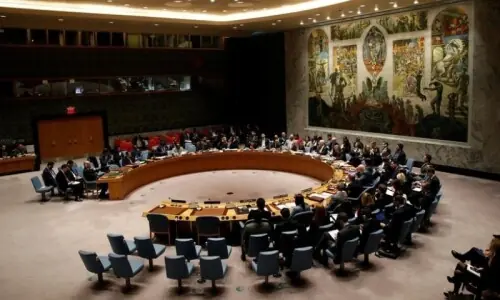
The UN Security Council has been stalemated with Russia and China vetoes of Western and Arab attempts to impose sanctions on Assad's government.
Saudi Arabia is circulating a draft General Assembly resolution demanding an end to the violence in Syria, backing political dialogue and transition and calling for Syria’s chemical weapons to be held secure.
However, General Assembly resolutions are not enforceable by sanctions or military intervention.
No date has been set for the introduction of the Saudi Arabia-sponsored, Arab-backed draft resolution.
Meanwhile, US President Barack Obama and Turkish Prime Minister Recep Tayyip Erdogan spoke by telephone Monday “to coordinate efforts to accelerate a political transition in Syria,” the White House said.
This “would include the departure of (Syrian leader) Bashar al-Assad and be responsive to the legitimate demands of the Syrian people,” the statement said.
Obama and Erdogan shared their concerns over the Syrian regime’s crackdown on opposition “and the deteriorating humanitarian conditions throughout Syria as a result of the regime's atrocities.”
Both promised to coordinate efforts to help the growing numbers of Syrians displaced by the violence within Syria or forced to flee over the border to take refuse in Turkey or other nations in the region.
The statement said US and Turkish teams “would remain in close contact on ways that Turkey and the United States can work together to promote a democratic transition in Syria.”
Ankara has become a champion of the uprising against Assad’s Syrian regime and has given refuge to large numbers of army defectors, who have formed the kernel of a rebel army, as well as tens of thousands of civilian refugees.
Some 44,000 Syrians fleeing unrest in their homeland have already flooded refugee camps in Turkey, and Obama paid tribute to Turkish generosity.