Are Pakistanis extremists?

From the Newspaper | | 1st August, 2012
84
Send to Kindle

THERE are two ways of effecting a change in a society: from top to bottom or from bottom to top. Conventionally, it has been believed — and development and political strategies are based on this notion — that changes at the top and the trickle-down effect will create an impact at the bottom, where it is needed.

Unfortunately, this approach has failed in our case for two reasons. First, in the absence of statesmanship in the leadership and its corruption, the vested interests at the top support the status quo. Hence they obstruct changes in the system or their policies for the benefit of the majority. Second, there is no pressure or demand from below to force those at the helm to reform themselves and the system they administer.

Most human rights activists fighting for change adopt the top-down approach. This means that any change in mindset comes about in a small class which the leaders can afford to ignore. Hence my scepticism of this approach, which includes advocacy as has been practised in Pakistan. This was my reaction when I received a lovely book from the Human Rights Commission of Pakistan, Inteha Pasandi sey Nijaat Mumkin hai. The optimistic tone of the title at least forces one to read it in the hope of finding solutions. Experts such as I.A. Rehman, Dr Mubarak Ali, Dr Pervez Hoodbhoy, Dr Mehdi Hasan, etc, give an excellent analysis of the extremism and militancy that plague this country today.

Will those who need to be convinced read this book? Or will this be another attempt to preach to the already converted? If the idea is to get the authorities to accept the enlightened suggestions put forward in the book, it is doubtful if these words of wisdom will actually change anything. Policymakers are the ones who are supposed to act when you demand a new social contract, revision of our textbooks or the introduction of economic justice by reforming our social and political structures. Will they? Not without public pressure from below.

Only when the masses feel the need for change will they create the demand that will force the government to act. In the absence of this demand the powers that be get away with all their anti-people shenanigans.

This demand also has to be mobilised and channelised. Change has been slow in coming to our society because we do not have leaders of public opinion to create a progressive mindset and give a focus to opinion at the grass roots. This is basically the function of political parties. They have, however, failed to play this role because our democracy — even in the phases when it has existed — has been a sham. The political representatives have not felt the need to gather their constituents behind them as they have devised other ways of winning votes.

Only activists with a liberal agenda working on the ground at the grass roots have managed to mobilise the people and effect some changes in their lives. But they have not made an impact nationally because their reach and resources are limited.

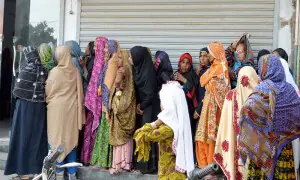
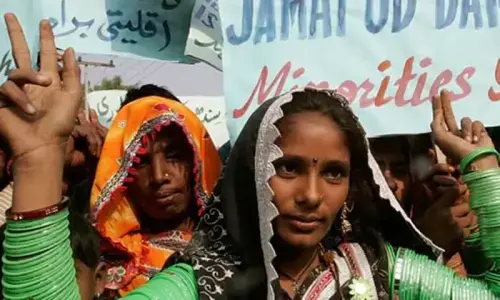
As a result, our society displays a dichotomy that is mind-boggling. The visible layer that is organised, educated and affluent — but is in a minority — demonstrates a growing trend towards religiosity and extremism. Some sections even tend to be militant. For the masses that live below the poverty line, religion is limited to going to the mosque, fasting in Ramazan and observing the ‘Islamic’ dress code. Their opinions cannot even be defined as being extremist, intolerant or militant in the way some opinion surveys project them to be.

As for disrupting law and order, that is beyond them. Parveen Rahman, director of the Orangi Pilot Programme Research Training Institute, who has been working at the grass roots in the low-income localities of Karachi and rural Sindh and Punjab, says she is surprised by the patience and lack of aggression shown by people in the face of extreme hardship created by the collapse of the state.

Apart from the terrorism unleashed by Islamist militants who are driven by their political goal of seizing power, the violence that is tearing our society apart is related to issues not of a religious nature.

The media, academia and the middle class have been penetrated by organised groups — be they the Islami Jamiat Talaba, the Jamaat-i-Islami, Al Huda — or parties that continue to play their proselytising role concertedly. They also provide welfare services through organised networks whose presence cannot be ignored. They win the confidence of the students and the mosque-going and TV-watching middle classes.

Parveen Rahman confirms that only by interacting with the people, identifying with them and ensuring that some benefits accrue to them can you win their trust and mobilise them.

In his insightful book, Pakistan: Social and Cultural Transformation in a Muslim Nation, Prof Mohammad Qadeer, a professor emeritus from Queen’s University, Canada, points out that developments in Pakistan have “widened the chasm between private and public spaces” with public interest being trumped by private commitments. This is reflected in pervasive corruption and inefficiency.

This has left people feeling isolated and insecure. The religious parties are scrambling to fill the vacuum so created, while liberal and secular opinion lags behind as it lacks adequate structures to counteract the religious thrust. This is the area that needs to be addressed by liberals if the country is to be saved from the scourge of religious extremism. The poor are no problem.
www.zubeidamustafa.com

COMMENTS

  1. poorly written. unnecessarily stretched to prove simple point/s. as usual blame game and nothing new really highlighted in the article. A narration of events that people already know. No forethought nether any solution driven. Poor effort.

  2. I bet you, Zubeida, no extremist is reading your article.
    I suggest you do a public service and open a free for all academy to indoctrinate progressivism and moderation into people.

  3. Liaqat Ali Khan the first Prime Minister was a great mind, right hand of Quide Azam and a brilliant politician. To say something against him would almost be a political blasphemy. But I can always ask a question. Why did he add that sentence in “The Objective Resolution” (which was not in line with the spirit of democracy) when Quide e Azam spoke of democracy vs. theocracy, which later encouraged religious parties to play hell with this beautify land?

  4. The vast majority , yes.

  5. All the well known terrorists have some link with Pakistan. Isn't it enough?

  6. ArshadPatel,Ohio,USA

    Pakistanis are not at all extremists. They are trying to break the shackles put to them by corrupt politicians, the feudal lords, the industrialists and the most inefficient police. Besides they are also resisting against the external terrorists which are threatening their freedom and survival.

  7. The answer lies in your question!

  8. Excellent article…….analyses the situation very well.

  9. Yes Pakistan has slowly become an extremist / fanatic country. Thanks to mullahs and the King of extremism Zia ul Haque.

  10. No, Pakistanis are NOT extremists.
    @andy fr dc: Yes, there are several countries on earth that showered flowers on murderers, e.g., the guy who killed of Israeli PM Yitzhak Rabin, was hailed as a hero by the right-wing Israelis. It's easy to single out Pakistan for the bad situation that they find themselves in.
    My conclusion: Zubeida is just another propaganda machine out to malign Pakistanis.

  11. Pakistan is a funny country. When I went there during Zia's time and told the people I was a Hindu from India they all wanted to take me home. The sentiment was truly overwhelmingly friendly nay brotherly. The same people hate India (love Indians though) the same sentiment prevails across the Wagah. I believe that Pakistanis are moderate by nature but easily misled in the name of religion and country through hate factories set up by the likes of Zaid Hamid and Hamid Gul

  12. How can you avoid extremism, when you see injustice and corruption in abundance, surrounding you. Lack of education does not help either. When you come across a good public speaker, who has extremist views, you will seriously consider following his/her preaching, since you don't know anything better and the leaders who are in charge are corrupt and have their own interest as their priority. Desperation leads to extremism. Our people are suffering and there are two things that they need the most – i) someone to believe in who can pull them out of this misery (religion and unfortunately it is the extremist who have manipulated the true teachings)and ii) someone to blame for their failings (western society). When these extremist "so called leaders" start feeding their views into the minds of these naive people, we end up with a society of extremist. It is very unfortunate, but this is how i see it.

  13. In all honesty,I can say with personal experience and a very close study that the vast majority of Pakistanis are extremists. They were not like this till Zia's era began. One have to observe them very closely to find this out. Their behaviour,attitude,way of life, every thing shows clearly their extreme out look and I am one of them except that I have been living in west for over 50 years where tolelance and moderation is hallmark of a daily life.

  14. china is not treating well to its muslim citizens,are they not extremist? unfortunately pakistan believes them big brother & india a big enemy where muslims enjoys more freedom then rest of the world..

  15. Dr. D. Prithipaul

    The demand for Partition and the creation of a theocratic state was made by anglicised middle class Muslims. The talk about who is extremist or not , about who is tolerant or not, is confusing. For example, after having worked together for two generations all the Muslim actors, directors, singers, musicians, script writers of the Bombay and Calcutta film centers left for Pakistan (both West and East). Pakistani academics working in secular universities in North America, in secular environments, still maintain their exclusionary mentalities. There is no such exclusively extremist or liberal Pakistani. Anwar Sadat used to say that it is wrong to speak of Israeli hawks and Israeli doves: they are all hawks. Likewise there is no liberal or extremist Pakistani. They are all extremists. Everything else is a juggling with words, with no meaning. But they project a collective delusion of difference.

  16. Raja imran Dhruggi

    There are many factors of expanding extremism in Pakistan.Iam agreed to the writer viewpoint but the major cause of extremism is poverty and lack of education.180 million people are residing in Pakistan and more than half of total are illiterate living in far flung areas of Pakistan,where there is no schools because our feudal lords don't like to educate them .people are hand to mouth and leading their lives below the poverty line.such people are easily religiously motivated and inspired by pseudo Mullas and so called religious factions which are pleasing the foreign donors by financing these innocent people and their families.most of the bomb blasters are unknown to he after effects of the act which they are going to undergo.Nationaistic approach is getting dimmed and dimmed every day because we have no goal,no aim .no nationalistic approach.no state governed policy which unite us for the common cause.its my request by commenting on this issue to the govt to stress on education.Educatoin is the solution of all growing problems including extremism