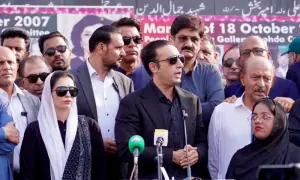
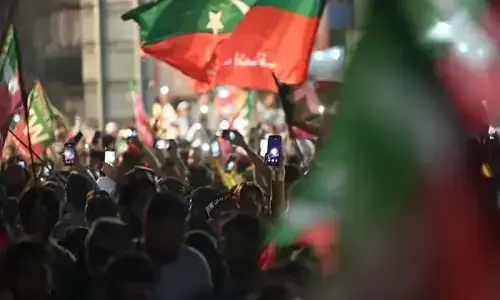
ELECTION season is here. The political leaders know no form of canvassing other than that of mud-slinging. Most of them can produce no documented evidence, but it is enough to start a vitriolic debate.
What betrays the low level of our electioneering is that no one has so far discussed any substantive issues. There have been attacks on the government in terms of the numerous crises that engulf the country today. Yet no party leader has actually analysed official policies on any burning questions or tried to offer his own solution. In other words, no one has shown us the light at the end of the tunnel. No party has announced a plan and the old manifestos that lay gathering dust have been dusted off and brought out where needed.
No one will really buy that. The voters — the few who still look up manifestos — are sceptical. They all know that the main problem with the education sector is the utter lack of political will and commitment on the part of those who execute policies. Unfortunately this will is also missing in the parties, not just in the government. Everyone is just scrambling for power with no agenda before them.
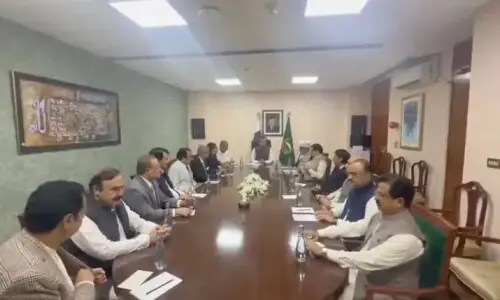
This was much in evidence last month when the Idara-i-Taleem-o-Aagahi convened what was termed a consultation with the political parties. So disinterested were the parties in being consulted that no representative had arrived by the time the function was scheduled to begin. Baela Jamil, the host, went ahead and started the proceedings without those who were supposed to understand how we, the voters, feel about the mess in the education sector.
The representatives did trickle in later, but after the children had presented their report on the more than one million signatures they had collected in four months demanding the right to education. Since no parliamentarian was present to witness their enthusiasm and pride or listen to their laments against inequalities in education (the children were from Lyari schools), one can’t expect any change.
When four lawmakers had arrived — from the PPP, MQM, PTI and JI — a semblance of consultation began but was punctuated by a lot of rhetoric; there was very little meaningful discussion. The discussant was Dr Ishrat Husain, the director of the IBA, who has turned the institute around since he took over, showing that change was possible if the commitment existed. Two observations he made were very succinct and should have made the parliamentarians think. One, education should be a non-controversial subject and all political parties should evolve a consensus on it. Two, the major problem in this sector is that of management and governance.
These should not be such unachievable goals. But who was listening? The parliamentarians were glancing at their watches as they prepared to leave.
What was an eye-opener was the revelation — at least for me — from Sharmila Farooqui who was representing the ruling PPP.
She informed the audience that the teachers in Sindh’s schools were selected by the World Bank, which also paid their salaries. That is the level to which we have sunk. The government does not want to waste funds on its teachers.
A charge commonly levelled by critics is that teachers are selected not on the basis of merit but of loyalty. Hence they are not necessarily good and education is being undermined drastically. Has the World Bank taken over this job itself? Do we know that whoever pays the piper calls the tune and its implications for education?
While we were being told this, the legislators kept clear of Article 25-A of the constitution, the supposed focus of the consultation. It is the least mentioned issue in parliamentary circles.
At another panel discussion organised earlier by the Sindh Education Foundation I had raised the issue of why the government was not framing a law on free and compulsory education. It was later that I learnt that a draft had been drawn up but the functionary from the education department who informed me about it was reluctant to pass it on to me. Perhaps she viewed it as a state secret, not to be told. Baela Jamil, a very resourceful person, sent me the draft much later.
I hope the government will circulate this draft before it is adopted as law. Many objections might be raised and it is better that they are debated in public during the lawmaking process.
The Annual Status of Education Report, 2011 shows that the standard of education in Sindh is the lowest in Pakistan. Is that surprising? It has long been suspected that the power-brokers in the province do not want the people they rule over to be educated. There was a time when landlords would not even allow schools to be opened in their jurisdiction. Now they ensure that if a school has been set up, children do not learn anything. The schools that function in the rural areas have nothing to offer children.
The right-to-education law needs to be strong so that good education is provided to all children. The bill doing the rounds is certainly flawed and has been drafted in such a way that it may never be implemented. Even if it is, it does not define the changes that are needed very clearly and the law might remain a dead letter on many counts — but more about that later.