



 5
5

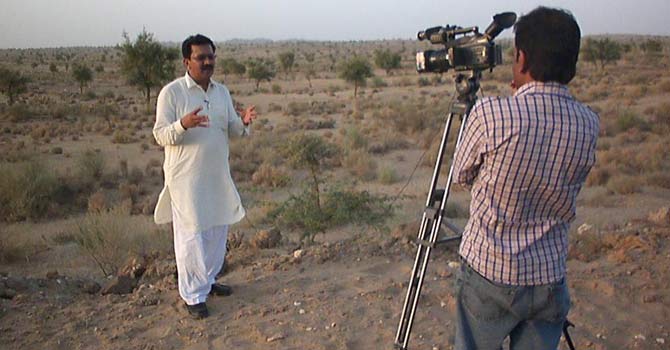
“I know we are expecting a guest but who is this Faiz, anyway?” The informer was asked.
“He’s coming from Hyderabad.”
“But which one of your friends is named Faiz?” The question persisted.
“Yaar he is a Khoso.”
“But… Anyway, we will see once he comes. I still don’t understand who this Faiz Khosao is.”
“Faiz Khoso from KTN TV. Tareekh Wala.”
“What?” Several voices shrieked with great interest and bewilderment.
“Saeen Faiz Khoso Tareekh Wala. Wow! Saeen, there will be festivity at mach (fire) tonight”, said the person who was the first one to be surprised at Faiz’s name. And so, a group of young men began discussing Sindh and its history, courage and ancestry, wealth and standing, honour and esteem. Amongst these tales of history, Faiz Khoso stood tall .
This is the story of a village in Sindh where journalists, intellectuals, historians, TV hosts and most importantly, a learned honest Sindhi was about to reach the far-away destination to record his TV program.
Sindhi cable television channel KTN’s series of ‘historical’ documentary series, which had surpassed a hundred episodes and on a Sunday in May, 2012, was to be broadcasted one last time.
With the arrival of the 21st century, the media industry went through a massive transition. Pakistani media went from print media to broadcasting media and this was made possible by private cable television channels. Now, after almost a decade, news broadcasting is still a work in progress. Where Urdu and English channels came in view, so did the first Sindhi news channel named ‘KTN’.
Sindhi print journalism has a steeped history; its roots can be found at the end of nineteenth century. It further strengthened after creation of Pakistan but the initiation of Sindhi news and journalism was through daily ‘Kawish’.
Around two decades ago, when Ali Qazi presided over the commencement of Kawish, there were more than a dozen Sindhi daily newspapers in circulation. Some boasted strong roots but gradually, aggressive reporting and modern layout made Kawish Sindh’s most popular daily.
When private TV channels went live in the country, Kawish Television Network came out with its acronym, ‘KTN’ and became the first complete news channel in the Sindhi language. Even today, its popularity remains strong. Aggressive reporting, straightforward conversation and love for Sindh are some of its unwritten basic principles.
Several years ago I met a traveller from Mumbai named Jay Prakash in Sukkur’s Sa’dhoo Bela temple. Prakesh’s parents had migrated from Hyderabad to India at the time of partition. Prakash told me that his father fought with the cable operator to be able to watch KTN channel. Now he tells me and the kids to watch this channel, and that it is a representation of Sindh. “Correct your Sindhi by listening to it.”
Jay Prakash’s father wanted KTN to improve his children’s language, but Faiz Khoso was two steps ahead of him. He was already a part of the KTN team. He was interested in history and its promotion, so he forwarded a proposal to the administration.
“At a time when no TV channel of Pakistan was airing a purely educational program; giving such a proposal required a lot of guts,” he tells Dawn.com. “But it’s the administration’s courage and appreciation that they took the risk and we were successful,” he adds, smiling.
Faiz proposed that a 50-minute documentary program be produced, covering Sindh’s cities, towns and villages. It was proposed that it also include Sindh’s history, views from historians and traditions kept alive by the elderly. The aim of the program was to revive Sindh’s forgotten heritage and discover new facets of history.
The idea was accepted after a briefing and it was decided that the first program would be on the awareness of history among the public.
“We went to bazaars, streets, educational institutions...everywhere. We asked people what they knew about history. The responses which we received were disheartening but instead of losing hope, we turned it into a victory. We started the program ‘Tareekh’ and after the first program, the response we received from the audience and Sindhi scholars was positive,” Faiz recalls.
‘Tareekh’ had its first weekly program broadcasted at 8pm on a Sunday of March, 2010. The documentary program then gained so much popularity throughout Sindh that the marketing team deemed it as a successful endeavour.
Faiz said, “These days Pakistani TV channels don’t give slots to purely educational programs, that too at primetime, it’s quite unlikely. This history documentary series changed the common perspective that the audience is not interested in educational topics and dry subjects like history.”
‘Tareekh’ was immensely successful in its two years. It was the first documentary film series to be made in Sindhi or maybe even Urdu which was focussed on one topic. Yet, one hundred episodes were broadcasted with a total airing time of around 5000 minutes. This program gained so much popularity throughout Sindh that it became my identity,” says Faiz Khooso.
Faiz was the researcher, host, script-writer and director. “Now, wherever I go in Sindh, people recognise me by this program and add ‘tareekh wala’ after my name. It makes me very happy.”
According to Faiz this series took him to far-away, dangerous places of Sindh. “At times police officials told us not to go, but we pursued. People who were branded as dangerous, greeted us affectionately. They opened their hearts and their houses for us. This is their love for their land, its history and those who present it on TV.”
Faiz Khoso says that Sindh’s greatest Sufi poet Shah Abdul Lateef Bhittai’s wife Syed Bibi was of Turkish origin. Sindh’s late historian Dr Nabi Bux Baloch had verified that Shah Bhatti’s father-in-law Mirza Mughal Baig’s grave was somewhere around Hyderabad but exactly where, nobody knew.
“Once when preparing for the program, we arrived at the Toor Ki graveyard in Tando Allayar. It was also known as Baiglaron cemetery. We presumed that Toor Ki was a distorted version of ‘Turkey’ and the word Baiglar was from ‘Baig’. This assumption is further strengthened by the fact that most Turks are buried here. Whilst reading gravestones there, we came across one and were left astounded. Our curiosity was accurate. The gravestone’s writing and year were of Shah’s time and it had the name ‘Mirza Mughal Baig’ inscribed on it. He was the same man who had the honour of being Shah’s father-in-law. We had made a historical breakthrough and several historians agreed with us,” Faiz said.
There were two cameramen involved in the filming of this series, Fahim Lodhi and Javaid Solangi.
“Initially we thought this would be an easy task but later realised that it is actually very difficult. Honestly, the more we progressed, the more enjoyable it became,” says Fahim.
Javaid Solangi agrees, “We faced obstacles but learnt a lot. Especially about our history, its understanding and learning from elders our historical evidences advanced our knowledge greatly.”
When it comes to obstacles Faiz says, “In terms of technicality, this was very difficult. We did not have access to archaic footage; it was very difficult to find old pictures of Sindh’s towns and villages. We had to narrate as well as show everything but we were able to make a hundred documentary films successfully.”
The executive director of Centre of Environment and Development, Nasir Panhwar, “Faiz’s program, possibly for the first time in Pakistan, portrayed the history of Sindh’s jungles. It showed such astonishing aspects that I was shocked. It was the history of Sindh’s jungles and environment.”
Nasir advised that KTN should make DVDs of these documentary films to make them accessible to the public.
The late historian Dr M. H. Panhwar had a multi-dimensional personality and a strong knowledge of Sindh’s history. He used to say that after Moen jo Daro, the following 2,500 years of Sindh’s history are lost and there is a need to excavate them. Our present history starts after those 2,500 years.
Unveiling history is the work of researchers and historians but surely the history Faiz wanted to uncover, understand and present; he was more successful than expected.
Within the time span of two years he has made a hundred documentary films on Sindh’s scattered history – 5,000 minutes of broadcast time and discoveries...
There lies a lot in these films.
There is a need for research institutes such as Institute of Sindhology and Sindh Archives to obtain copyright of these films and save them in their video libraries so that an important piece in Sindh’s history is available for future researchers and historians.




























