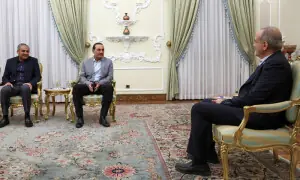
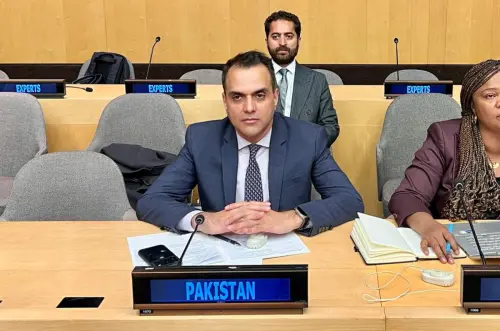
WASHINGTON: The US State Department confirmed on Thursday that an American diplomat had a meeting with Pakistani officials at the Ministry of Foreign Affairs in Islamabad as Pakistan lodged its first formal protest with the United States over drone strikes.
“I can confirm that one of our diplomats did meet with the Ministry of Foreign Affairs today,” a US State Department official told Dawn.
“Regarding Pakistan’s official statement on that meeting, I refer you to the Pakistani government,” said the official when asked for comments.
A US think-tank, the American Security Project, hosted a roundtable discussion on the effects of US drones policy while an international advocacy group released a report saying that since 2004 the United States had launched a total of 336 drone strikes in Pakistan, killing between 2,532 and 3,251 people.
The London-based Bureau of Investigative Journalism noted that 284 of these strikes were ordered by the Obama administration. The strikes also killed between 475 and 879 civilians. A total of 175 children were also killed. Between 1,204 and 1,332 people were injured.
The group, which is seeking legal action to stop the strikes, explains that the numbers vary according to the sources providing the information.
“The CIA’s drone campaign in Pakistan has killed dozens of civilians who had gone to help rescue victims or were attending funerals,” says the report, adding that “at least 50 civilians were killed in follow-up strikes when they had gone to help victims.”
According to the information provided by the American Security Project, the Washington seminar on drones focused on the “big picture”, noting that much of the current discourse had eschewed strategic concerns in preference for tactical concerns.
The participants claimed that those who were more familiar with drones were “generally less hostile to their presence and use”.
Christine Fair of Georgetown University spoke on the use of drones in Fata, where there were three specific groups with which the US must contend: enemies in common with Pakistan, allies of Pakistan who are enemies of the US, and militant enemies of Pakistan that are of little strategic interest to the US.
“As a result, Pakistan will cooperate with the US on some targets, while undermining joint efforts on others,” she said.
Ms Fair said that in data collection and analysis, one must remain cognizant of the question of who was the US trying to kill, the influence of “circular reportage” and “social desirability bias” on data availability and quality, and the need for confirmations of deaths through burials or proof of existence.
Ultimately, Ms Fair noted, this data was needed to determine the efficacy of US drone programmes, but it was consistently “obfuscated” on official levels in both the US and in Pakistan.
Will McCants of Johns Hopkins University said the US faced four increasingly difficult questions in evaluating the strategic use and effects of drones:
• Do drone strikes drain US resources more so than other policy options?· Do drone strikes reduce the threat of a large-scale attack on the homeland that would result in unbalanced policy?
• Are drone strikes empowering terrorists in recruitment efforts?
• Are drone strikes breeding future anti-American sentiments?
Aaron Zelin of the Washington Institute for Near East Policy provided insight into how terrorist organisations such as Al Qaeda were adapting to the presence of drones and incorporating them into their logistics and propaganda.
Mr Zelin pointed out that drone strikes were degrading the ability of these organisations to conduct training: in Pakistan, organisations were moving away from Fata towards more urban environments.
In the question and answer session, some participants questioned the quality of data obtained from local reports in Pakistan, and asked why some terrorist organisations were exploiting lethal drone strikes as a recruitment tool while others had not.