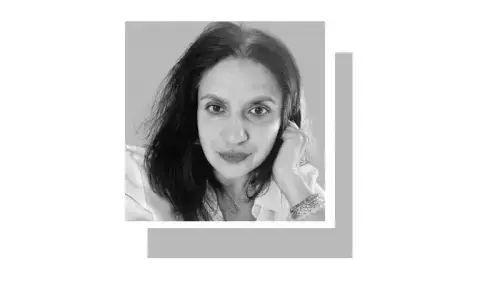
She is famous; she belongs to a family where fame resides; she is married to a person whose name guarantees success in whatever he does, yet she carries no airs about her. Talking to her leaves one with a pleasant feeling and meeting her for the first time makes one feel that one has known her for a lifetime.
The lady under discussion is Imrana Maqsood, who is not only Anwer Maqsood’s wife but has an identity of her own. She has not only written many story books for children but has a number of novels and TV plays to her credit.
Her life story is deceivingly simple but interesting. After spending a carefree childhood in Badayun, India, she came to Pakistan in 1960 as a 13 or 14-year-old girl. She has fond memories of her childhood of playing and having fun and has expressed this in profound detail in her book, coauthored by her sister Aamra, Karachi Halwa Aur Badayun Kay Pairay. “The book shows who we were and how we used to live. Even though there was a lot to brag about, we have not exaggerated anything, but have narrated our childhood and talked about our living conditions in a lucid way,” she chuckles.
Coming from a small town to a city like Karachi was a big change and it took some time for the family to settle down. Back in India, Maqsood’s father was the chairman of the Municipal Corporation and a quaint lawyer; he was so settled that initially he didn’t want to migrate because he was worried he would not be able to settle anywhere else at his age, even though the older children had been sent to Pakistan. Some time after the departure of the older children, he didn’t quite feel like living there and after disposing of the property, he joined his family in Karachi.
Interest in literature and writing is in her genes. She has taken her love for literature from her father as did her elder sister “who used to write while the family was still in India and her writings used to be published in Pakistani magazines”. She studied English and Hindi at school and though she knew Urdu back in India, her interest in the language developed after coming to Pakistan.
Maqsood started writing when she was in class eight and has written for her school, college and university magazines as well as for other magazines. Later she shifted to writing stories for children. Interestingly, she had a brief stint with the OUP — about two years — as a part-time worker during which she wrote about 20-25 books for them and even wrote a few books for the Book Group. All her prize-winning books were published by Ferozsons, where she has been freelancing for some time. Moreover, she is a three time recipient of the National Book Foundation’s Best Book Award.
Her television writing started some 12 years back when her first play Salma Aur Sitaray went on air. “I was writing Rabia Zinda Rahay Gi but then Aliya Imam asked me to write Salma Aur Sitaray and so it came first. Then Rabia Zinda Rahay Gi came on ARY and as they say, there was no looking back for a long time.”
Her sister Aamra is the coauthor of a number of her TV plays but when it comes to books, she writes alone except for Karachi Halwa Aur Badayun Kay Pairay which was her first book for grown-ups.
She may not be writing as frequently as she used to — she still has a few plays awaiting recording and a novel that is in print. At present, she is working on a cook book which only has vegetarian recipes. Why just vegetarian? “Everybody can cook meat but making tasty vegetables is difficult. There are so many cookbooks but none of them are for cooking vegetables only. Since I love vegetables, I thought of preparing vegetarian recipes,” she explains.
With the couple both into writing, do they criticise each other’s work? Maqsood is frank, “Though Anwer hardly writes a bad script, I do tell him if I don’t like something. But Anwer watches my plays quietly (if he watches in my presence) and doesn’t say anything to me; often he watches it at the TV station. Perhaps he doesn’t want me to do this, but since he doesn’t say anything, why should I take action? He should have the courage to say what he wants or doesn’t like.”
Maqsood is satisfied being at home, managing her household and enjoying her children and grandchildren. She has performed in a couple of stage plays but discontinued it as she believed it was not the thing for her. She could not meet her children for more than a month as she would be out late for rehearsals, etc., and felt that she shouldn’t be doing it. “I don’t want to go out of my home loop; I want to keeps things in my control at home.”
Many people find working from home a bit difficult as there are too many distractions. Perhaps that is the reason for Maqsood not being able to write much. “I cannot write unless there is total silence around, but if I have a project in hand or a target, I delineate all my work and sit down to write”. She reminisces that when Anwer Maqsood underwent heart surgery, she was working on a play with her sister. And since they had a target, she even worked during his illness. This is truly an epitome of self control and commitment.
As a loving mother, she stood by her son Bilal when he chose music as his profession and formed a band (Strings) with Faisal Kapadia after graduating from the Indus Valley School of Art and Architecture. She had supported him when he joined the school despite people telling her that it is not a degree awarding institution. However, just a day before he was to graduate, the institute got the charter for awarding degrees and he received one. Such is her faith that her children will get what is good for them.
Maqsood is content and happy with all she has in life. She claims she had a very bad temper but learnt to analyse and control it and that has benefited her a lot. She thinks this is the reason why she is free from many health problems such as blood pressure, etc.
However humble Maqsood may be, she takes pride in the fact that her family is matriarchal, where women are in positions of power and authority. While she is appreciative of Anwer Maqsood’s position and work, she discloses that even though he looks very powerful, he is very weak, to the extent that she has to keep pushing him to do things. And if she doesn’t, he will not be as productive. According to her, after her death he will be in a state of shock for two days and would soon fall apart.