0
0

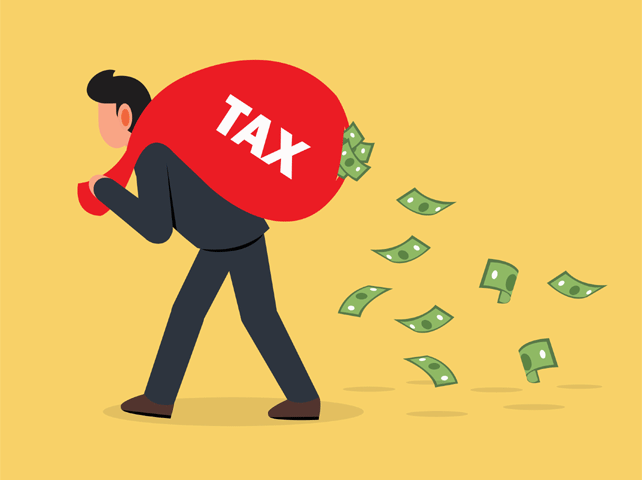
EVER since the government has raised the rates of Gas Infrastructure Development Cess on different users of gas (excluding the domestic consumers) in the budget for the current fiscal year, a large number of manufacturers across the country have moved the courts against the levy.
The primary factor leading manufacturers to obtain court orders against the levy and its increase, of course, pertains to their concern about the increase in their input costs. They also fear that their money will not be used for the purpose for which the tax is being raised. Some believe that the funds thus collected may finance the federal budget or (partly) may be used to liquidate the inter-corporate circular debt in the power sector.
Both are legitimate concerns.
The Peshawar High Court stopped on Aug 28 the government from collecting GIDC from Rahman Cotton Mills on a petition that seeks declaration of the levy as illegal and unconstitutional.
Other identical petitions seeking court orders scrapping the tax are expected to be heard over the next few days.
According to industry sources in Lahore, in Sindh, over 4,000 industrial units are said to have moved the court individually or through their associations looking forward to the scrapping of the levy on the entire industry in the province.
In Lahore, at least 50 petitions either seeking removal of GIDC or against the hike in its rates have been filed, according to the Lahore Chamber of Commerce and Industry.
The GIDC has been imposed under the Gas Infrastructure Development Cess Act 2011 passed by the parliament in November last year to raise funds for financing the Turkemenistan-Afghanistan-Pakistan-India (TAPI) and Iran-Pakistan gas pipeline projects as well as creating infrastructure for importing Liquified Natual Gas (LNG) to fill growing supply gaps in the country, especially Punjab.
The budget documents for 2012/13 show that the government hopes to increase GIDC collection from Rs8 billion last financial year to Rs30 billion this year.
The low collection under the GIDC during last year was because of two factors: the levy was imposed on Jan 12 and the rates charged were low.
To achieve the target it has, through money bill 2012/13, hiked the cess rate on feed stock for the fertiliser producers to Rs300 per mmbtu from the previous Rs197 per mmbtu, Rs300 per mmbtu for CNG stations in Balochistan, Khyber-Pakhtunkhwa and Potohar region in Punjab from Rs147 per mmbtu and Rs200 per mmbtu in Sindh and the rest of Punjab from Rs79 per mmbtu, Rs100 per mmbtu for industrial consumers and captive power from Rs13 per mmbtu, Rs100 per mmbtu for independent power producers (IPPs) from Rs70 per mmbtu and Rs100 for Wapda, Karachi Electric Supply Company (KESC) and Gencos (generation companies) from Rs27 per mmbtu.
“The increase in the cess rate will substantially push our cost of doing business at a time when we desperately need to bring it down to stay competitive in the region and the rest of the world,” says a Lahore-based businessman, who did not want to be named.
Thus, all the sectors are of the view that the amount of cess should be raised in a phased manner, especially when the government is yet to start investing the money collected on building infrastructure for importing gas.
The All Pakistan Textile Mills (Aptma) has already convinced the government to halve the rate of cess for industrial consumers and captive power plant to Rs50 per mmbtu to reduce the burden on industry. Other users should also get similar treatment, even if not the same treatment.
The business community demands that a mechanism may be evolved to ensure utilisation of the cess on building infrastructure for import of gas and LNG.
Aptma leader Gohar Ejaz, who is credited to have convinced the petroleum and finance ministers to reduce gas cess for industry, has proposed an independent board comprising ministers of petroleum, power and finance and businessmen to evolve a strategy for utilising the GIDC funds for creating infrastructure to ensure immediate import of LNG to remove gas shortages.
“The industry suffered gas supply suspension for 180 days during the last year at the expense of jobs, fresh investment and exports. The shortages are likely to increase this year.
The developing situation demands that we take measures to import LNG over the next three months to avert another severe energy crisis,” he tells Dawn.
He warns many more factories will close in Punjab if the energy shortages are not resolved. “We are already seeing the mills closing down, laying off workers and defaulting on bank loans because the industry is starved of gas for three days a week even during summer,” he says.
It may be recalled that the National Assembly’s standing committee on finance too had suggested inclusion of some kind of restriction in the GIDC legislation that the amount collected be utilised for gas infrastructure development.
Still, the high rates of the cess and suspicions about the government’s plans about its utilisatin are not the only factors that have motivated the industry in Sindh to oppose the fee.
The feeling that the industry in Sindh is being taxed to pay for development of infrastructure for filling supply gaps in Punjab too has made many to challenge its imposition in the courts.
“Gas shortages may be restricted to Punjab for the time being. But the substantial growth in the demand for gas by different users epecially domestic consumers and IPPs means that the government will soon be compelled to start rationing the fuel in Sindh as well,” says an office-bearer of the Lahore Chamber of Commerce and Industry.
“They (the industry in Sindh) must realise that they are not financing the industry in Punjab by paying GIDC. They are financing their own future even though Punjab’s industry may appear to be the main beneficiary at the moment.”