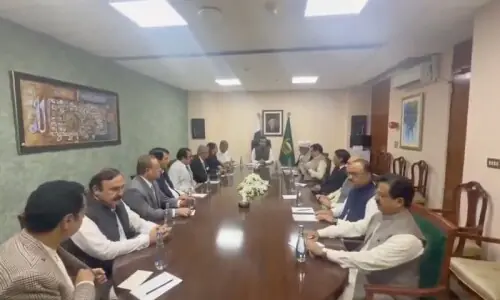
AT the time of writing, roughly a day and a half after the promulgation of the Sindh People’s Local Government Ordinance (SPLGO), members of PML-F, ANP, and NPP tendered their resignations from the provincial coalition.
Shaharyar Maher, the PML-Q provincial minister followed suit, in what now appears to be a personal decision.
Around the same time, Sindhi nationalist groups led by Ayaz Palejo, last seen protesting in Islamabad, and Qadir Magsi, have called for a strike against the ‘conspiracy to divide Sindh’ on Sept 13. PML-N, the party with precisely zero members in the Sindh Assembly, has backed their call, as has the PTI, that quickly voiced their two cents using an office-bearer from Punjab.
It is entirely possible, though, to take a slightly less cynical view of the affair, and explain the new local government system as an outcome of a procedurally democratic political settlement between the two largest political parties in the province. An outcome which one could say emerges from the same maturity and adroitness that the PPP has exercised in other difficult legislative processes at the federal level.
In countries like Pakistan, where political parties are relatively disorganised at the micro level and where avenues for broad-based collective action have remained historically constrained, political settlements and elite consensus emerge as the primary tools for administrative and structural reform.
What essentially happens is that political elites, mostly in the shape of political parties, attempt to find solutions that are acceptable to the other side by offering certain concessions and settling for fewer gains. The exact size of concessions and gains is determined by structural factors, by external pressures, and by perceptions about who would lose the most in the case of a deadlock/disagreement.
In the SPLGO case, for example, a two-and-a-half-year process has resulted in the PPP and MQM settling on a hybrid version of the 2001 ordinance, under which the five divisional headquarters have been granted the status of metropolitan corporation (more or less the same as a ‘City District Government’) to be headed by a mayor.
The rest of the districts will have district councils headed by a chairman. The MQM has agreed to give up its demand to devolve policing to the district level, while also agreeing to maintain a separate revenue bureaucracy under the provincial government.
Given the time frame, a mutual understanding on this particular sticking point might prove to be of considerable benefit to both parties. For the PPP, it offers them some breathing space in terms of coalition politics at the federal level, especially near another court hearing, and possibly future support when and if the provinces question pops up in the National Assembly.
For the MQM, this settlement opens up the opportunity to re-engage with their service delivery-hungry electorate and to strengthen their political and organisational control over Karachi and Hyderabad — whenever local bodies polls take place.
That said, it is rare to end up with a consensus that is acceptable to all stakeholders, regardless of their size and strength. As mentioned at the start, initial reactions by the smaller coalition partners, the nationalists, and even the Punjab-based parties, highlight a flat refusal to buy into the PPP-MQM settlement for a number of reasons.
Firstly, the timing of the ordinance is legitimately questionable, specifically as it has been promulgated so late in an electoral term when general elections are just around the corner. Over and above this, some have perceived it as a way of privileging Karachi over the rest of the province, and as capitulation of the PPP in front of the party representing the Urdu-speaking population.
A basic review of the law’s text, which will soon be made public, reveals that the critiques centred on the ‘division and sale of Sindh’ are fairly misplaced. Councils in all metropolitan corporations — which means Karachi and Hyderabad, but also predominantly Sindhi cities like Sukkur, Larkana and Mirpurkhas — will, under the law, perform the same functions and exercise the same powers as assigned to district councils in all other parts of Sindh, under Section 39 of the ordinance.
The only difference is that the five divisional headquarters will also have responsibilities and powers regarding zoning, planning, infrastructure development and beautification — a fairly sensible proposition given the size of the cities in question.
There are valid critiques to be made of this ordinance — such as on the amount of participatory potential in the proposed structure, stipulations concerning pro-poor development, indirect elections for mayors and district chairmen, and the amount of fiscal autonomy being granted to lower tiers of government — but it appears that current opposition leans more towards being expediently political, as opposed to being substantively constructive.
What’s more problematic is that despite there being a fair degree of consensus on the need to devolve service delivery and broadening the scope of representation in our political system, the fragmented nature of the polity, along a wide variety of crevices, makes it incredibly difficult to develop cross-sectional support for larger reform efforts, such as this one.
The PPP high command has proven to be quite skilful at managing dissent in the past, and it remains to be seen if they’ll be able to win back their smaller coalition partners in the province.
What would be unfortunate though is if the existing polarisation on the issue of local government results in a breakdown of this PPP-MQM settlement, and a rollback to a completely bureaucratic and outdated mode of local governance. In such an instance, it’s fair to say that those losing out most would be the people of Sindh.
The writer is a freelance columnist based in Islamabad.
umairjaved87@gmail.com Twitter: @umairjav