0
0

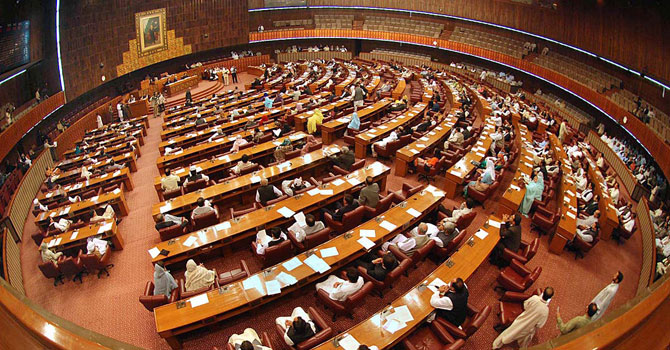
ISLAMABAD: After slumbering for four long years, the Pakistan Peoples Party (PPP) has woken up with a startle to push for local government elections.
The PPP at the centre really has no say in the matter as local governments are a provincial subject, but legislators in conversations put forth two explanations.
One, with the party’s sizeable presence in the four provinces, the PPP has a remote shot at clean-sweeping the local polls, which would certainly affect its performance in the general elections.
The other explanation is that the hype being generated is merely a pre-election stunt by President Asif Ali Zardari and Co, who have an entirely different game plan in mind.
There is merit to the second argument. It’s just months before March 2013 when the country braces for the general elections, and any publicity is good publicity.
Nevertheless, the PPP would have to work hard to come up with a plausible explanation for the delays on its part.
The local government system is granted under the Constitution, and the PPP had committed to its implementation when it had signed the Charter of Democracy with the Pakistan Muslim League-Nawaz (PML-N).
Clause 10 had clearly stated: “Local bodies election will be held on a party basis … and constitutional protection will be given to the local bodies to make them autonomous and answerable to their respective assemblies as well as to the people through regular courts of law.”
However, as Dawn conducted interviews with political leaders across party lines, it emerged that no other party had any interest in local government elections at the moment.
And they have good reason to be cautious: losing in the local government elections could spell disaster. Even the PPP, according to independent observers, has an edge in Sindh alone.
The Muttahida Qaumi Movement (MQM) supports the local government ordinance in Sindh after all its concerns were addressed, and an alliance were to come about between the PPP and MQM, it would easily cinch both urban and rural areas.
However, the PPP lacks an ally on the lines of the MQM elsewhere.
“The PPP cannot take the risk of holding local elections in other provinces,” said a senior party leader.
For instance in Punjab, Pakistan Tehreek-i-Insaf (PTI) has upended the political divides with its mini tsunamis.
“Neither the ruling PML-N nor the PPP are sure about their chances of success if the provincial government manages to hold local government elections,” he said.
This could be the reason that Mian Shahbaz Sharif hinted at holding local elections on a non-party basis in the largest province of the country.
On the other hand, his brother PML-N Chief Mian Nawaz Sharif has simply called out the PPP for looking for excuses to delay the next general elections.
A senior PML-N leader said that the party just could not afford any distractions at the moment, but is not entirely averse to the idea of local government.
If the PML-N wins the next elections, which the party leadership is hoping for, “we will be having no issue in holding local elections, but, not now,” he said.
Even the provincial chapter of the PPP has failed to show any enthusiasm on the subject.
But that is for the future: the provincial government has yet to come up with new laws for local governments, and there is absolutely no chance of local government elections being held in Punjab.
The situation is no different in Khyber Pakhtunkhwa, where the Awami National Party (ANP) is running the government in alliance with the PPP.
Besides facing the scourge of militancy, the party has dismally failed to improve governance in the province.
Given its poor performance and low popularity levels, the ANP leadership cites poor law and order conditions for not holding the elections.
Balochistan is nobody’s land, where tribal sardars rules the roost.
Elections or no elections, except few urban constituencies, a certain set of families have tight control in their respective areas.
Talking to Dawn, Dr Rashid A Khan, former head of Political Science Department, Punjab University Lahore, explained that there were three grounds for political parties to dither on local elections.
One, political parties come to power after military dictatorships, who first want to streamline themselves at central and provincial levels, before getting into local elections.
And they don’t want to carry on with the local governments propped up by the military men, therefore, take time to remodel local governments as per their own requirement.
Secondly, wary of factionalism or losing elections, which might affect their governments at provincial or federal levels, the political parties prefer not to take risk.
Thirdly, Dr Khan argued, local government simply meant transfer of financial and executive authorities to grassroots level, which perhaps didn’t suit top level political leadership.
However, Dr Khan said with the continuation of democracy in the country, political parties will have no other option but to hold local government elections.