0
0

KABUL: Nato-led forces are scaling back joint operations with Afghan forces after a spate of “insider attacks” in which Afghan recruits turned their weapons on Western allies, officers said on Tuesday.
The move marked a setback for the coalition's war strategy, as the planned withdrawal of Western troops hinges on training and advising Afghan forces to take over security by the end of 2014.
Under the new order, most joint patrols and advisory work with Afghan troops will only be conducted at the battalion level and above, while cooperation with smaller units will have to be “evaluated on a case-by-case basis and approved by RC (regional) commanders”, the International Security Assistance Force (Isaf) said in a statement.
As the so-called “green-on-blue” attacks have grown, US commanders have gradually acknowledged the assaults pose a serious threat to the war effort and have struggled to stem the problem.
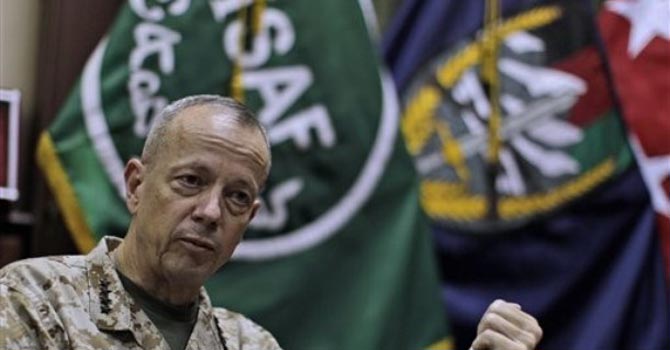
The commander of US and Nato troops in Afghanistan, General John Allen, “has directed all operational commanders to review force protection and tactical activities in the light of the current circumstances,” a US military officer in Washington said in an email.
“This guidance was given at the recommendation of, and in conjunction with, key Afghan leaders,” said the officer, who spoke on condition of anonymity.
“This will likely lead to adjustments in exactly how, when and where Isaf troops operate, especially during the current period of heightened tension.”
The decision came after six Isaf soldiers were shot dead by suspected Afghan police and after the Taliban destroyed six US fighter jets in an unprecedented assault on a major base in the south.
The change by Nato also followed violent protests by Muslims around the world over an amateur, American-made film deemed to insult the Islamic faith.
It was unclear how the new rules for joint patrols might affect the plan to pull out the bulk of Nato combat forces, as some Afghan units are considered ill-prepared to begin operating independently.
More than 30 insider attacks have claimed the lives of 51 troops in the Nato-led coalition so far this year, sowing mistrust between the Western force and its nominal allies and casting doubt on Isaf's “shoulder-to-shoulder” motto.
Commanders believe only a quarter of the assaults are the result of infiltration by Taliban insurgents and that the remainder were caused by cultural clashes and personal grievances.
Afghanistan's defence ministry said earlier this month that it had arrested or sacked hundreds of Afghan soldiers for suspected insurgency links.