0
0

— Photo by Online
ISLAMABAD: Almost all the mainstream political parties decided to stay away from a multi-party conference called by Hafiz Mohammad Saeed’s controversial Jamaatud Dawa, leaving the forum for the representatives of various Islamic parties and a few other right-wing groups to evolve a “consensus” on what the strategy of Pakistan and the rest of the Muslim world should be to deal with the United States on a despicable video made by an American-based Coptic Christian on the Holy Prophet (PBUH).
Invitation was extended to every top politician and political party, from Prime Minister Raja Pervez Ashraf to PML-N’s Mian Nawaz Sharif, Imran Khan and leaders of the Awami National Party. But when the meeting started at a hotel in the federal capital, it became quite evident that none of the mainstream parties and leaders wanted to be represented at a show where an extreme position was expected to be taken on the controversial video and other related issues.
And this is exactly what happened at the forum. Hard-hitting speeches to denounce the United States and the West continued to echo throughout the meeting, with every prominent Islamic leader trying to beat the others in his call for taking extreme action against the US. If some called for expelling the American ambassador from the country, a few others threatened to block the Nato supplies for Afghanistan if, according to them, the US president decided against banning the video and punishing its producer.
Hafiz Saeed, whose organisation is on the list of banned groups in the US and remains on the watch-list of Pakistan government, was the most active of all. Primarily it was his show, and often during the course of the speeches he was seen moving from leader of one Islamic group to the other, apparently to make sure that a consensus was evolved on hard-hitting resolutions, not only against the United States but also to criticise leaders of many other Muslim countries for their “inaction” on the issue.
Other prominent leaders presented at the conference included JUI’s Maulana Fazlur Rehman, Jamaat-i-Islami’s Syed Munawar Hasan, leader of his own faction of JUI Maulana Samiul Haq, Maulana Mohammad Ahmed Ludhianvi, former ISI chief General Hamid Gul, and many others.
In a declaration adopted at the end of what was called ‘Tahaffuze Hurmate Rasool conference’, prominent Muslim states like Saudi Arabia, Turkey Egypt and others were asked to play their effective role in framing a law against blasphemy of all the holy Prophets including Muhammad (PBUH).
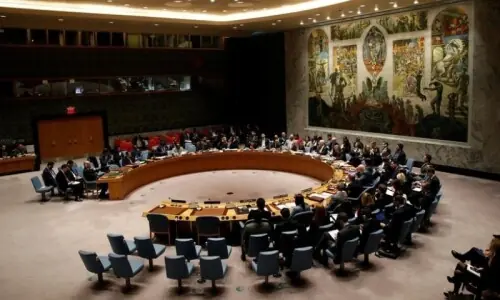
“This national consultative conference of leading religious political leaders demands of the Muslim countries’ rulers to establish a Muslim United Nations, and a separate unified defence and economic system if the UN and Security Council refrain from framing anti-blasphemy law,” the declaration said.
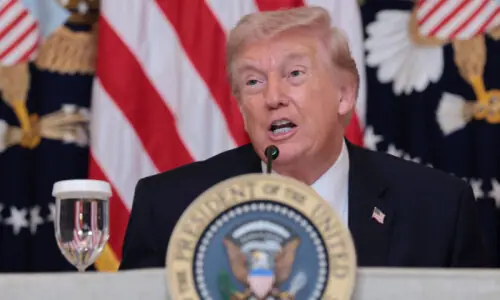
Frustrated over the lack of extreme action by the Muslim countries, some of the speakers called upon the Muslim countries to pull out of the so-called global war against terror and use the ‘oil weapon’ to get their demands met. They said American President Barrack Obama in his speech at UN General Assembly by refusing to ban the blasphemous film had laid the foundation for a ‘war of civilisations’.
At the same time some of the Islamic leaders threatened that if the Muslim rulers failed to heed their calls, the ‘Muhibbane Rasool’ (lovers of Holy Prophet) would come out on the street and would not return to their homes until these countries were swept by Islamic revolution.
A demand to convene a conference of the Organisation of Islamic Cooperation was also made to enable member countries to sit together and plan a unified strategy to counter blasphemous actions of the Western world. They said the OIC should demand the handing over of the blasphemer film-maker to them for trial and meting out punishment. The speakers described restoration of Nato supplies without getting the drone attacks halted as a collective suicide.