0
0

PESHAWAR, Sept 26: Khyber Pakhtunkhwa Information Minister Mian Iftikhar Hussain has said that the government could take decision concerning delay in general election in the country in case operation is started in North Waziristan Agency. However, he said that the decision whether to launch operation in North Waziristan or not was yet to be taken.
“If action is carried out in the tribal region, the government could take a decision concerning delay in the election while keeping in view prevailing circumstances,” the minister said while speaking as chief guest at a dialogue titled “challenges for democracy in upcoming general elections” at Peshawar Press Club on Wednesday. The dialogue was held under the auspices of Liberal Forum Pakistan, Khyber Pakhtunkhwa chapter.
Mr Hussain, however, dispelled the impression that the situation was deliberately created to delay the elections, saying that the government wanted to complete its five-year term and hold elections as per constitution. He said that independent and autonomous election commission was vital to holding free and fair elections in the country.
The minister said that the government still believed in holding talks with Taliban on the basis of a guarantee to avoid violence and live peacefully. He asked the stakeholders in ongoing war against terrorism, including Afghanistan, Pakistan and Elections may face delay, says information minister America, to come up with a joint strategy as any individual step would not bear fruit.
He said that the government did not need to classify good and bad (Taliban) and friend and foe, but should take across the board action to restore sustainable peace in the region. He said that the provincial government would not accept any foreign dictation.
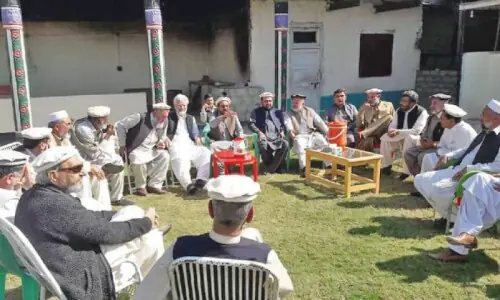
Other speakers at a dialogue, arranged to discuss pre-election scenario, stressed the need that the election commission should be fully independent and autonomous institution in order to ensure transparent elections in the country.
Most of the speakers said that a unified approach should be adopted to remove obstacles hindering the election process and create atmosphere conducive for conducting transparent and timely elections. The participants said that the all political forces should come up with a joint strategy to pave the way for fair general elections, fearing that uncertain situation prevailing in the country could delay the elections.
Pakistan Tehrik-i-Insaf provincial leader Shaukat Yousafzai said that free and fair elections were impossible under the existing system. He said that it could be a difficult task to conduct elections in prevailing uncertain situation in the country, particularly in tribal areas. He said that due to inconsistency of democratic system and policies the democratic norms could not flourish. He stressed the need for framing independent policies instead of accepting others’ dictations.
Jamiat Ulema-i-Islam (JUI-F) provincial information secretary Haji Jalil Jan called upon all political forces to come up with a joint formula for holding general election in a benefiting manner. He said that the situation wasn’t conducive to holding elections in the country. He also criticised media for allegedly resorting to character assassination political leaders except MQM’s Altaf Hussain.
The JUI-F leader said that a large number of innocent civilians had been wounded or displaced as result of prolonged military operations in tribal areas. Under this precarious situation, he said, holding elections could be a daunting task for the political parties.
Jamaat-i-Islami leader Hafiz Hashmat said that pre-poll rigging should be eliminated, as it was the biggest hurdle to holding fair elections in the country. “A joint mechanism should be devised to end the practice in all parties and to nurture fair norms of electoral system,” he said.
The JI leader called for granting party tickets to candidates from lower and middle class. He claimed that 50 per cent of voter lists had mistakes, which should be rectified prior to the elections.
Other representatives of different political and religious parties, and members of civil society organisations also spoke on the occasion.