0
0

UNITED NATIONS: The Afghan and Pakistani presidents and the British prime minister met in New York on Wednesday as the international community accelerated its efforts to achieve reconciliation in Afghanistan before the 2014 withdrawal of US and Nato forces from there.
Also, in his address to the UN General Assembly, Afghan President Hamid Karzai recognised Pakistan’s critical role in the reconciliation process but warned that the recent shelling of Afghan villages might undermine peace efforts.
President Karzai also urged the United Nations to delist Taliban leaders from its register of terrorist individuals as he was seeking reconciliation with the insurgents.
“The leadership of Pakistan, Afghanistan and United Kingdom today reaffirmed their commitment to continue to work for the goals of regional peace, stability and development and for the elimination of the scourge of terrorism from the region,” said an official statement issued after the summit.
Last week, Foreign Minister Hina Rabbani Khar also discussed the reconciliation process with US Secretary of State Hillary Clinton in Washington amid media speculations that the United States, Pakistan and Afghanistan had reached some understanding on the key issue.
During the trilateral summit of Pakistan, Afghanistan and the UK on the sidelines of the UN General Assembly, President Zardari, President Karzai and Prime Minister David Cameron “discussed the pressing issues in the fight against terrorism,” the statement said.
On Tuesday, the Afghan core group, which includes the United States, Pakistan and Afghanistan, also met in New York to review the peace process.
Another trilateral group, which comprises China, Pakistan and Afghanistan, is scheduled to meet soon in Islamabad.
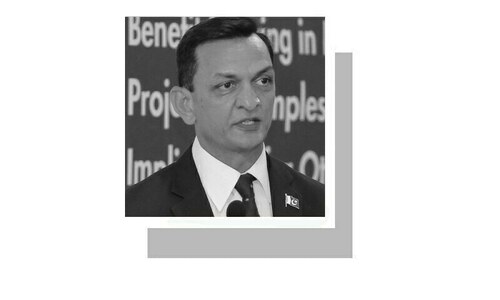
“All international forces are working together to prepare a roadmap for peace in Afghanistan,” Masood Khan, Pakistan’s designated permanent representative to the UN, told a briefing in New York. “We hope for a positive outcome.”
President Zardari, while highlighting the importance of durable peace and stability in Afghanistan, underscored the need for an Afghan-led and Afghan-owned peace process in Afghanistan. He said that Pakistan supports an intra-Afghan dialogue.
President Zardari and President Karzai appreciated the constructive role being played by the United Kingdom. Prime Minister Cameron reiterated the commitment of the United Kingdom to support Afghanistan and Pakistan in “working out solutions for peace and stability in the region and in their quest for socio-economic development of their people,” the statement said.
Earlier, in his speech to the General Assembly, President Karzai urged the United Nations “to help facilitate the peace process, I ask of the United Nations Security Council to extend its full support to our efforts.”
In particular, he urged the 1988 Taliban’s Sanctions Committee to take more active measures towards delisting of Taliban leaders as a step to facilitate direct negotiations.
President Karzai said that in its pursuit of peace, Afghanistan “remain(s) hopeful for the critical role that our neighbour, the Islamic Republic of Pakistan, has to play.”
Over the recent years, “we have engaged our friends in Pakistan in a close dialogue in support of the Afghan peace process. It is a dialogue that, we believe, is critical for Pakistan’s own security, and the security of the wider region and beyond,” Mr Karzai said. “We are deeply committed to our brotherly relations with Pakistan, but are aware of the challenges that may strain our efforts at building trust and confidence,” he said.
“Such incidents as the recent shelling of Afghan villages risk undermining the efforts by both governments to work together in the interest of our common security,” Mr Karzai warned.
The Afghan president repeated his allegation that the roots of terrorism were across the border in Pakistan.